Learn the key differences between PSAT and SAT including test structure, scoring, difficulty, and how to convert PSAT score to SAT score for better preparation.
he PSAT and SAT are built on the same digital format and test the same skills, but they serve completely different purposes. The PSAT does not count for college admissions -- it is a practice test. The SAT is the exam colleges use to evaluate applicants. Taking the PSAT in 10th or 11th grade gives students a low-stakes preview of the test format, a benchmark score to work from, and -- for high-scoring juniors -- a pathway to the National Merit Scholarship.
Introduction
PSAT vs SAT – Understanding the differences between these tests is important for high school students preparing for college applications. The PSAT (Preliminary SAT) is a practice test that helps students assess their skills and get ready for the SAT. Usually taken in 10th or 11th grade, it covers similar subjects like Math, Reading, and Writing, providing a strong foundation for the SAT.
Colleges use the SAT to evaluate students' readiness for college-level work. Compared to the PSAT, the SAT is more challenging and detailed. Moving from PSAT to SAT requires improving test strategies and growing subject knowledge.
Both tests are produced by College Board and delivered digitally through the Bluebook app. Both use the same two-section structure -- Reading and Writing, and Math -- each split into two adaptive modules. The scoring scales are different (320-1520 for the PSAT versus 400-1600 for the SAT), but the day-to-day preparation for one transfers almost entirely to the other. This guide covers every meaningful difference: purpose, structure, timing, scoring, cost, difficulty, and how to use your PSAT score to set a realistic SAT target.
What is the PSAT?
The PSAT -- officially called the PSAT/NMSQT (Preliminary SAT / National Merit Scholarship Qualifying Test) -- is a practice exam administered by College Board to high school students in 10th and 11th grade. It was redesigned in digital format in fall 2023 for US students and now mirrors the structure of the Digital SAT almost exactly.
Key facts about the Digital PSAT/NMSQT:
Total duration: 2 hours and 14 minutes
Total questions: 98 (same as the Digital SAT)
Sections: Reading and Writing (54 questions, 64 minutes) and Math (44 questions, 70 minutes)
Format: Computer-adaptive, taken on the Bluebook app
Score range: 320-1520
Only the PSAT/NMSQT taken in 11th grade qualifies students for the National Merit Scholarship Program
A calculator is available throughout the Math section via the built-in Desmos tool
The essay section no longer exists -- it was removed in 2021
The PSAT is free for most students when administered through their school. Verify current pricing at collegeboard.org before registering.
What is the SAT?
The SAT is a standardized college admissions exam produced by College Board, taken by students in 11th and 12th grade. Colleges and universities across the US use SAT scores as one measure of a student's readiness for college-level work. Most US colleges -- including many test-optional schools -- accept SAT scores as part of their admissions process.
Since spring 2024, the SAT has been fully digital in the US. It is taken on the Bluebook app and uses a computer-adaptive format -- your performance in the first module of each section determines the difficulty of the second module.
Key facts about the Digital SAT:
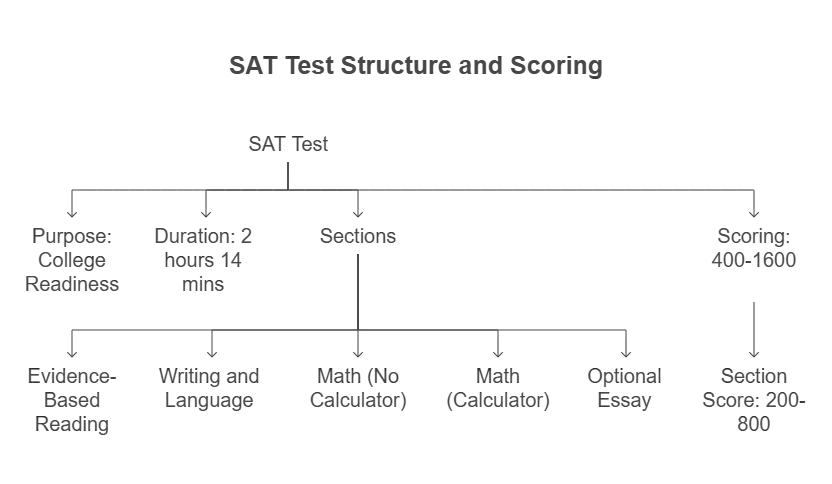
Total duration: 2 hours and 14 minutes
Total questions: 98
Sections: Reading and Writing (54 questions, 64 minutes) and Math (44 questions, 70 minutes)
Score range: 400-1600
Format: Computer-adaptive, taken on the Bluebook app
A calculator is available throughout the entire Math section
The essay section was permanently removed after June 2021
Registration fee: $55 standard -- verify current pricing at collegeboard.org
PSAT vs. SAT: Key Differences
For high school students preparing for college applications, the PSAT vs SAT debate is a common topic. Although these exams evaluate comparable reading, writing, and arithmetic ability, they vary in numerous important ways, including difficulty, goal, and score.
Knowing these differences helps students plan and prepare effectively. The important variations between the two tests are broken out here:
Feature
PSAT/NMSQT (Digital, current)
SAT (Digital, current)
Purpose
Practice test + National Merit Scholarship qualifying test
College admissions test
Who takes it
10th and 11th graders (juniors qualify for National Merit)
Reading and Writing, Math (2 adaptive modules each)
Reading and Writing, Math (2 adaptive modules each)
Format
Computer-adaptive (Bluebook app)
Computer-adaptive (Bluebook app)
Score range
320-1520
400-1600
Section score range
160-760 per section
200-800 per section
Score validity
Not sent to colleges
Sent to colleges for admissions
National Merit
Qualifies 11th graders for National Merit Scholarship
Does not qualify
Calculator
Allowed throughout Math (Desmos built in)
Allowed throughout Math (Desmos built in)
Essay
Removed
Removed
Cost
Free for most students (school-administered)
$55 standard fee -- verify at collegeboard.org
Difficulty
Slightly easier -- fewer advanced Math concepts
Slightly harder -- includes all advanced Math concepts
Why Take the PSAT?
Particularly for high school students getting ready for the SAT, taking the PSAT has several benefits.
Qualify for the National Merit Scholarship Program: Each year, over 1.3 million high school juniors take the PSAT/NMSQT, with approximately 50,000 receiving recognition for scholarships.
Effective Practice for the SAT: The PSAT matches the SAT in content and structure, and helps students in targeted SAT preparation.
Track Academic Progress: Students who take the PSAT 8/9, PSAT 10, and PSAT/NMSQT can monitor their academic growth through detailed score reports and focused study plans.
Get Exposure: The PSAT stimulates real test conditions, reducing anxiety and improving time management skills for future exams like the SAT or ACT.
Get update from college and university: By opting into the College Board’s Student Search Service, students can receive information from colleges and scholarship programs that match their interests and qualifications.
Why Take the SAT?
The SAT is crucial for college admissions, scholarship opportunities, and academic placement, offering a standardized measure of student readiness.
College Admissions: The SAT is a key component of the college application, helping admissions officers evaluate your readiness for college-level work.
Scholarship Opportunities: Many colleges and organizations use SAT scores to award scholarships. A high SAT score can improve your chances of receiving financial aid.
College Placement: Your SAT score may be used to determine your eligibility for specific college programs or placement in advanced courses.
National Benchmark: The SAT provides a standardized measure of academic ability, allowing colleges to compare applicants from various high schools on a common scale.
Prepare for Future Success: Performing well on the SAT can open doors to prestigious colleges, offering better opportunities for career advancement and personal growth.
Future Career Opportunities: Some employers may consider SAT scores as part of their hiring process, particularly for entry-level positions
Test Structure: PSAT vs. SAT
For PSAT
For SAT
PSAT/NMSQT (Digital)
SAT (Digital)
Reading and Writing -- Module 1
27 questions, 32 minutes
27 questions, 32 minutes
Reading and Writing -- Module 2
27 questions, 32 minutes (adaptive)
27 questions, 32 minutes (adaptive)
10-minute break
--
--
Math -- Module 1
22 questions, 35 minutes
22 questions, 35 minutes
Math -- Module 2
22 questions, 35 minutes (adaptive)
22 questions, 35 minutes (adaptive)
Total questions
98
98
Total testing time
2 hours 14 minutes
2 hours 14 minutes
Score range
320-1520
400-1600
The structure of the Digital PSAT and Digital SAT is nearly identical -- the same two sections, the same number of modules, the same number of questions, and almost exactly the same total time. The meaningful structural difference is content difficulty: the SAT includes all advanced Math concepts while the PSAT excludes a small number of higher-level topics. The preparation you do for the PSAT transfers almost directly to the SAT, which is why taking the PSAT seriously -- not just sitting for it -- is the most efficient SAT preparation available.
Benefits of Preparing for the SAT and PSAT Together
Combining PSAT and SAT study helps students improve their confidence and proficiency. Below are some success-oriented detailed benefits and techniques.
Aspect
PSAT
SAT
Purpose
Practice test to assess readiness and qualify for scholarships (e.g., National Merit).
Official college entrance exam used for admissions and scholarships.
Test Familiarity
Builds familiarity with test structure and question types.
Preparation feels familiar due to PSAT practice.
Time Efficiency
Studying for PSAT builds foundational skills for SAT.
SAT prep strengthens PSAT content, making study time more productive.
Score Insight
PSAT scores help predict SAT performance using score conversion tools.
SAT performance can be improved through awareness gained from PSAT results.
Strategy Building
Helps develop strategies and manage time effectively.
Advanced strategies can be applied confidently, building on PSAT experience.
Scholarship Potential
Qualifies top scorers for National Merit Scholarships and related awards.
Higher scores improve eligibility for a wider range of college scholarships.
PSAT vs. SAT: Scoring and Sections
The PSAT vs. SAT assess similar intellectual skills, but they differ in structure, scoring, and difficulty. Below is a comparison of their main components and scoring criteria.
The PSAT vs SAT have different costs associated with them, reflecting their purpose and scope:
Aspect
PSAT
SAT
Base Cost
Free for most 10th & 11th graders (many schools offer it as a practice test)
$55 (base fee)
Optional Essay
Not included
$16 (optional)
Late Registration
Not typically applicable
$30 additional
Score Reports
Not typically charged
$12 per recipient
Purpose Reflection
Practice test
College admissions exam. That's why SAT generally carries a higher cost.
Always verify current fees at collegeboard.org before registering, as pricing can change.' -- This protects against future fee changes making the page inaccurate.
Why is the SAT More Challenging Than the PSAT?
The SAT is more challenging than the PSAT because it is designed for college admissions and tests higher-level skills. The questions on the SAT are more complex, requiring deeper problem-solving and critical thinking. The math section includes advanced algebra and data analysis, while the reading passages are longer and more difficult.
In the digital format both tests take nearly the same amount of time -- 2 hours 14 minutes for the PSAT and 2 hours 14 minutes for the SAT. The difference in difficulty comes from content, not duration. The SAT includes advanced Math concepts that the PSAT excludes, and the reading passages on the SAT tend to be more complex and dense. Students who score near the top of the PSAT range often find the SAT Math section noticeably harder for exactly this reason.
PSAT to SAT Score Conversion
Your PSAT score and your SAT score sit on the same scale and measure the same skills, which means your PSAT result gives you a meaningful prediction of where you will likely land on the SAT -- before you have taken it.
The scales are slightly offset. The PSAT tops out at 1520 while the SAT tops out at 1600. A student scoring 1200 on the PSAT is demonstrating roughly the same academic performance as a student scoring 1200 on the SAT at that point in time. College Board confirms that the two scores are designed to be comparable, though the PSAT does not test all the advanced content that appears on the SAT, which means very high PSAT scorers may still find the SAT Math section harder than their PSAT score suggests.
College Board does not publish an official PSAT-to-SAT concordance table for the Digital format. The most reliable data comes directly from your College Board score report -- log in at collegeboard.org after your PSAT to see a detailed breakdown of your performance by section and skill area.
In general terms: both tests share a common vertical scale, which means a score of 1200 on the PSAT reflects roughly similar academic skills as a 1200 on the SAT taken the same day. Most students improve between 50 and 100 points from their PSAT score to their actual SAT score through structured preparation. Students who work consistently on their weak areas can improve more.
The most practical use of your PSAT score is not the total number but the section breakdown. Your College Board score report shows your performance across Reading, Writing, and Math sub-domains. The areas where you score lowest relative to your overall performance are exactly where targeted SAT preparation will have the most impact.
If your PSAT Math score is holding down your total, focus your SAT preparation on advanced algebra, data analysis, and the problem types where you lost points. If Reading and Writing is the weaker section, focus on evidence-based reading and standard English conventions -- these have the highest question counts and the biggest score impact in that section.
For a structured week-by-week SAT preparation plan, see our complete SAT study guide. If you want personalised support with PSAT results and SAT target-setting, Find Our College's SAT coaching program walks through this individually with each student.
▶ What is the main difference between the PSAT and SAT?
The main difference is purpose. The PSAT is a practice test that does not count for college admissions -- it gives students early experience with the test format and qualifies 11th graders for the National Merit Scholarship Program. The SAT is the official college admissions exam that colleges use to evaluate applicants. Both tests now use the same digital format and assess the same skills.
▶ How long is the PSAT compared to the SAT?
Both the Digital PSAT/NMSQT and the Digital SAT take 2 hours and 14 minutes. Both tests have the same structure -- 98 questions across four adaptive modules -- with a 10-minute break between the Reading and Writing section and the Math section.
▶ How does PSAT to SAT score conversion work?
PSAT and SAT scores sit on comparable scales. A 1200 on the PSAT reflects roughly the same academic performance as a 1200 on the SAT at that point in time. College Board publishes official concordance tables at collegeboard.org that show the full conversion range. Your PSAT section breakdown -- not just the total -- is the most useful guide for targeted SAT preparation.
▶ Is the PSAT easier than the SAT?
Yes, slightly. Both tests use the same digital format and cover the same subject areas, but the SAT includes a small number of advanced Math concepts that the PSAT does not. The overall question difficulty ceiling is higher on the SAT. However, preparation for the PSAT transfers almost directly to the SAT, which is why taking the PSAT seriously is the most efficient early SAT preparation available.
▶ Do colleges see PSAT scores?
No. PSAT scores are not sent to colleges and play no direct role in college admissions. Only SAT scores are used for admissions. The one exception is the National Merit Scholarship Program -- juniors who score high enough on the PSAT/NMSQT may receive National Merit recognition and scholarship opportunities through that programme.
Cookie Consent
We use cookies to improve your experience on our site. By using our site, you consent to cookies.