
Best PhD in Data Science Programs
Explore the top PhD in Data Science programs. Learn about admission needs, costs, career paths, program timelines, and whether a data science PhD is worth it.
Data is no longer just supporting decisions; it is driving innovation, shaping policy, and transforming entire industries. A PhD in Data Science places you at the forefront of this transformation and equips you to create new algorithms, lead high-impact research, and solve problems that cannot be addressed with traditional analytics alone.
Introduction
A PhD in Data Science is the highest academic qualification in the field and is designed for students aiming to advance research, influence technological innovation, or pursue senior leadership roles in academia, industry, and government. According to the U.S. Bureau of Labor Statistics, the median annual wage for data scientists exceeded $110,000, reflecting the strong market value of advanced analytical expertise in the data science profession.
For students pursuing a phd in data science in the USA, these programs offer access to globally ranked universities, federally funded research opportunities, and strong industry collaboration, which makes the degree both academically rigorous and professionally rewarding.
What is Data Science?
A multidisciplinary field that integrates statistical analysis, computing techniques, mathematical models, and subject-area knowledge to derive valuable insights from both structured and unstructured data is called Data Science. It focuses on turning large volumes of raw data into actionable knowledge that supports informed decision-making.
Key aspects of data science include:
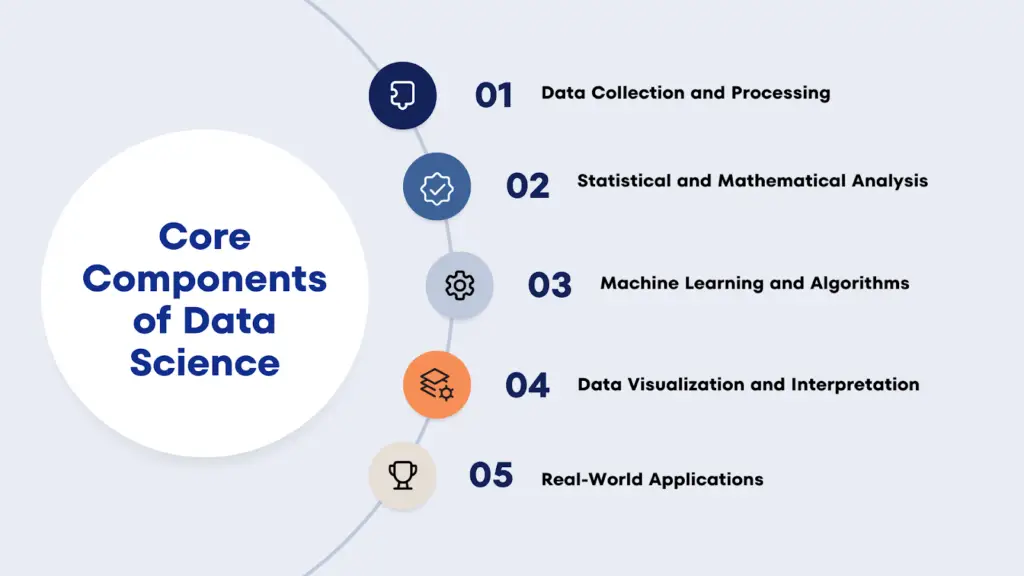
- Data Collection and Processing: Gathering data from multiple sources and preparing it for analysis through cleaning, integration, and transformation.
- Statistical and Mathematical Analysis: Applying probability, statistical modeling, and quantitative methods to identify trends and relationships within data.
- Machine Learning and Algorithms: Building predictive and classification models that enable systems to learn from data and improve performance over time.
- Data Visualization and Interpretation: Presenting insights through dashboards, charts, and reports to support strategic and operational decisions.
- Real-World Applications: Using data science techniques in healthcare, finance, technology, education, and public policy to solve complex problems.
At the doctoral level, phd data science programs emphasize advanced research and innovation rather than applied analysis alone. Students focus on:
- Developing new algorithms, models, and analytical frameworks
- Improving large-scale data systems and computational efficiency
- Advancing ethical, responsible, and scalable data usage
- Contributing original research that influences industry practices and academic knowledge
This research-powered approach prepares graduates to lead innovation across industries such as healthcare, finance, technology, and government.
Best PhD in Data Science Programs
Selecting from the best PhD in Data Science programs requires evaluating academic quality, faculty expertise, research output, and industry connections. Below are some of the top PhD programs in data science that you can choose from.
| S.No | College Name | State | Mode (Online / OnCampus) |
|---|---|---|---|
| 1 | The University of Chicago | Illinois | OnCampus |
| 2 | New York University | New York | OnCampus |
| 3 | Eastern University | Pennsylvania | Online & OnCampus |
| 4 | The University of Texas at Dallas | Texas | OnCampus |
| 5 | University of Virginia | Virginia | OnCampus |
| 6 | National University | California | Online |
| 7 | New Jersey Institute of Technology | New Jersey | OnCampus |
| 8 | Worcester Polytechnic Institute | Massachusetts | OnCampus |
| 9 | Rowan University | New Jersey | OnCampus |
| 10 | Columbia University | New York | OnCampus |
| 11 | Harrisburg University | Pennsylvania | OnCampus |
| 12 | Kennesaw State University | Georgia | OnCampus |
| 13 | University of Washington | Washington | OnCampus |
| 14 | Southern Methodist University | Texas | OnCampus |
| 15 | University of California San Diego | California | OnCampus |
| 16 | University of North Carolina at Charlotte | North Carolina | OnCampus |
| 17 | Arizona State University | Arizona | OnCampus |
| 18 | Utah State University | Utah | OnCampus |
| 19 | Northwestern University | Illinois | OnCampus |
| 20 | Boston University | Massachusetts | OnCampus |
Admission Requirements for PhD in Data Science Programs
Admission to PhD in data science programs is highly competitive and strongly focused on research potential rather than coursework alone. Universities look for applicants who demonstrate strong analytical skills, academic readiness, and a clear interest in contributing original research to the field.
While specific criteria vary by institution, most programs expect applicants to meet the following requirements:
- A bachelor’s or master’s degree in data science, computer science, statistics, mathematics, or a closely related field.
- A strong academic record, typically a minimum GPA of 3.0, with competitive programs often favoring higher GPAs.
- GRE scores, which are optional at many universities but may strengthen an application when submitted.
- Letters of recommendation from academic faculty or research supervisors who can assess the applicant’s research ability and technical skills.
- A well-written statement of purpose outlining research interests, career goals, and alignment with the program’s faculty expertise.
- Prior research experience, technical projects, or published work is highly preferred and can significantly improve admission chances.
International and domestic students applying for a PhD in data science in the USA must also meet English language proficiency requirements, such as TOEFL or IELTS scores, where applicable. Some universities may additionally require interviews or faculty matching as part of the selection process.
Benefits of a PhD in Data Science
Earning a PhD in Data Science provides significant academic, professional, and long-term career advantages. Beyond technical training, doctoral programs focus on independent research, critical thinking, and advanced problem-solving skills that are highly valued across industries.
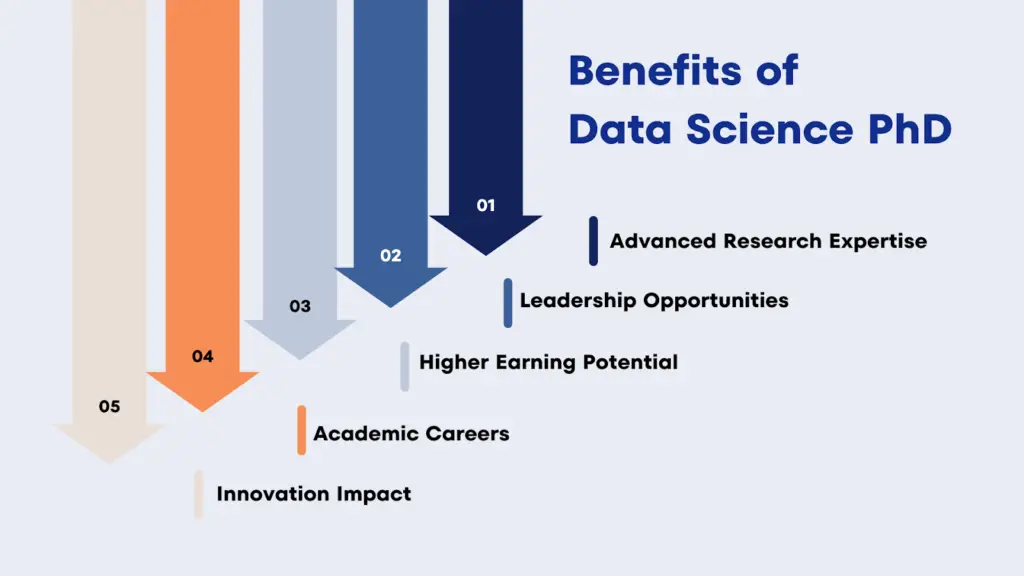
- Advanced Research Expertise: Gain deep knowledge in machine learning, artificial intelligence, and advanced analytics while conducting original research that contributes to the data science field. Students develop the ability to design, test, and validate complex models at scale.
- Leadership Opportunities: A doctoral degree prepares graduates for senior and strategic roles in industry, government agencies, and research institutions, where they lead data-driven initiatives and guide technical teams.
- Higher Earning Potential: Graduates with a PhD often qualify for high-level research, consulting, and leadership positions that offer stronger long-term earning potential compared to bachelor’s or master’s degree holders.
- Academic Careers: A phd in data science is typically required for tenure-track faculty roles, postdoctoral research positions, and advanced research scientist roles at universities and national laboratories.
- Innovation Impact: Doctoral research allows students to contribute new knowledge, tools, and methodologies that shape the future of data-driven technologies and influence real-world applications across sectors.
How long does a PhD in data science take?
A PhD in Data Science typically takes four to six years to complete, depending on the university, research focus, and the student’s academic background. Programs are designed to balance advanced coursework with independent research and dissertation development.
The overall timeline may vary based on several factors, including:
- Prior academic background and whether the student enters with a master’s degree
- Complexity and scope of the chosen research topic
- Dissertation requirements and publication expectations
- Availability and structure of funding, such as fellowships or research assistantships
Most phd in data science programs include structured coursework during the first one to two years, followed by qualifying or comprehensive examinations. The remaining years are primarily dedicated to dissertation research, publications, and academic or industry collaborations.
Career Opportunity for PhD in Data Science
Graduates of PhD in data science programs are qualified for advanced, research-related, and leadership-oriented roles across industry, academia, and government. With deep expertise in analytics, machine learning, and artificial intelligence, doctoral graduates often move into high-impact positions that influence strategy, innovation, and policy
| Career Role | Career Description | Average / Median Annual Salary (US) |
|---|---|---|
| Data Scientist | Develops advanced analytical models to interpret complex datasets. Supports strategic decision-making using predictive analytics and machine learning. | $112,590 (2024, median) |
| Machine Learning Researcher | Designs and improves machine learning algorithms and models. Conducts experimental research to advance AI capabilities. | $123,991 (2025, average) |
| AI Scientist | Conducts advanced research in artificial intelligence and deep learning. Builds scalable AI systems for real-world applications. | $130,719 (2025, average) |
| Research Scientist | Leads original research projects in data science and computational methods. Publishes findings in peer-reviewed journals or institutional reports. | $130,112 (2025, average) |
| University Professor (Data Science) | Teaches undergraduate and graduate courses in data science and analytics. Conducts funded research and mentors doctoral students. | $116,005 (2025, average) |
| Quantitative Analyst | Builds statistical and mathematical models for financial and risk analysis. Supports investment, pricing, and forecasting strategies. | $115,210(2025, average) |
Note: Actual earnings may vary significantly depending on factors such as geographic location, employer type, industry sector, years of experience, and level of responsibility.
FAQ’s
▶ Is it worth it to get a PhD in data science?
Yes. A PhD in Data Science is worth it for students interested in advanced research, leadership roles, or academic careers. It offers strong job security, long-term earning potential, and opportunities to influence innovation.
▶ Is a 3.4 GPA too low for a PhD?
No, a 3.4 GPA is generally competitive for many PhD in data science programs, especially when combined with strong research experience, recommendations, and a clear research proposal.
▶ How much does a PhD in data science cost?
Tuition for a PhD in Data Science typically ranges from $26,000 to $60,000 per year, depending on the university. However, most programs offer full funding through tuition waivers, stipends, and assistantships, which can significantly reduce or eliminate out-of-pocket costs.
▶ Is a data science PhD difficult?
Yes. A PhD in data science program is academically demanding and research-intensive. However, students with strong analytical skills, persistence, and research interest can successfully complete the program.