

Top PhD in Cybersecurity
Explore the top PhD in cybersecurity programs. Learn about admission needs, funding, online doctorate options, and long-term career paths in cybersecurity.
As cyber threats continue to grow across governments, businesses, and critical infrastructure, the demand for advanced cybersecurity expertise has never been higher. A PhD in cybersecurity prepares students to become leaders in research, policy, and advanced cyber defense.
Introduction
What does it take to stay ahead of cyber threats that grow more complex every year? For students seeking the highest level of expertise in digital security, a PhD in cybersecurity offers the answer.
This advanced degree focuses on original research in areas such as system security, cryptography, artificial intelligence in security, and cyber defense frameworks. According to the U.S. Bureau of Labor Statistics, employment for information security analysts is projected to grow by over 29% from2024 to2034, underscoring the rising demand for advanced cybersecurity knowledge.
Designed for leadership roles in research, academia, and advanced industry innovation, a doctorate in cybersecurity equips graduates with great analytical skills and the ability to solve complex, real-world security challenges.
Best Doctorate in Cybersecurity Programs
The best doctoral programs in cybersecurity are typically offered by research-intensive universities. These programs emphasize original research, interdisciplinary study, and collaboration with government agencies or private organizations.
| S.No | College Name | State | Mode (Online / OnCampus) |
|---|---|---|---|
| 1 | Northeastern University | Massachusetts | OnCampus |
| 2 | Arizona State University | Arizona | OnCampus |
| 3 | Walsh College | Michigan | Online & OnCampus |
| 4 | Capitol Technology University | Maryland | Online |
| 5 | University of Colorado Colorado Springs | Colorado | OnCampus |
| 6 | New York University | New York | OnCampus |
| 7 | The George Washington University | California | Online |
| 8 | Dakota State University | South Dakota | Online |
| 9 | Colorado Technical University | Colorado | Online |
| 10 | Augusta University | Georgia | OnCampus |
| 11 | Marymount University | Virginia | Online & OnCampus |
| 12 | Carnegie Mellon University | Pennsylvania | OnCampus |
| 13 | National University | California | Online |
| 14 | Northwestern University | Illinois | OnCampus |
| 15 | Atlantic International University | Hawaii | OnCampus |
| 16 | Sam Houston State University | Texas | OnCampus |
| 17 | University of North Florida | Florida | OnCampus |
| 18 | Ontario Tech University | Ontario | OnCampus |
| 19 | University of Idaho | Idaho | OnCampus |
| 20 | University of Plymouth | United Kingdom | OnCampus |
Many universities also offer a PhD in cybersecurity in an online or hybrid format, allowing working professionals to pursue doctoral studies while continuing their careers.
What is required to get a PhD in Cybersecurity?
Admission requirements for a PhD in cybersecurity vary by institution, but most programs look for strong academic preparation, research readiness, and subject-matter depth. Below are the common requirements students should expect:
- Relevant Master’s Degree
Applicants typically need a master’s degree in cybersecurity, computer science, information systems, or a closely related discipline. - Strong Technical and Academic Background
A solid background in mathematics, programming, networking, and systems architecture is essential. These skills support advanced coursework and research in areas such as cryptography, secure systems, and threat modeling. - Minimum GPA Requirement
Most PhD in cybersecurity programs require applicants to have a strong academic record, typically a cumulative GPA of at least 3.5 in prior graduate-level coursework, to demonstrate readiness for doctoral study.
- GRE Scores (Often Optional)
Many universities have waived GRE requirements, especially for applicants with strong academic records or professional experience. However, some competitive programs may still request scores to assess quantitative and analytical skills. - Statement of Purpose (Research-Focused)
Applicants must submit a detailed statement outlining their academic background, research interests, and long-term goals. - Letters of Recommendation
Most programs require two to three letters from professors, researchers, or industry professionals. These letters should highlight the applicant’s academic ability, research potential, and readiness for doctoral-level study. - Research or Professional Cybersecurity Experience
Prior research projects, published work, or professional experience in cybersecurity roles can significantly strengthen an application. - Additional Requirements for Online Programs
For a doctorate in cybersecurity online, universities may require proof of professional experience in cybersecurity-related roles.
What are the Benefits of a Doctorate in Cyber Security Online?
Pursuing a doctorate in cybersecurity online allows students to earn the highest academic credential in cybersecurity while maintaining professional and personal commitments. These programs are structured to deliver the same academic rigor, research depth, and faculty expertise as on-campus doctoral programs. Key benefits include:
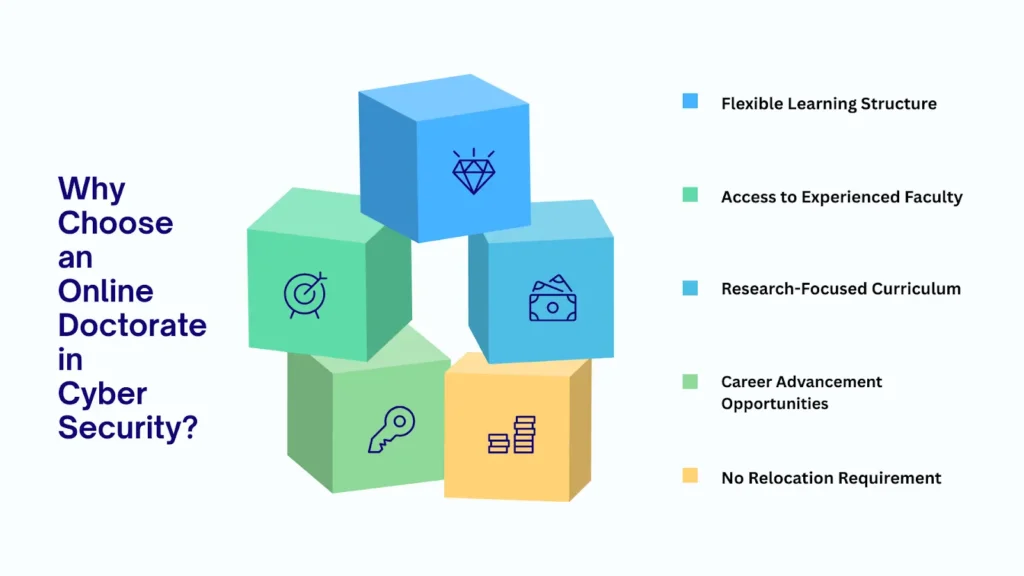
- Flexible Learning Structure
Online doctoral programs offer flexible schedules, enabling working professionals to balance advanced studies with full-time employment and other responsibilities. - Access to Experienced Faculty
Students in an online PhD in cybersecurity are taught and mentored by the same faculty members who lead on-campus research and doctoral instruction. - Research-Focused Curriculum
The curriculum emphasizes original research, critical analysis, and dissertation work aligned with emerging cybersecurity challenges and industry needs. - Career Advancement Opportunities
Graduates are well-positioned for senior leadership, research, and policy-making roles in academia, government, and private organizations. - No Relocation Requirement
Online delivery eliminates the need to relocate, allowing students to enroll in top doctoral programs without geographic constraints.
An online doctorate in cybersecurity is especially attractive to professionals seeking long-term career growth and leadership roles in advanced cybersecurity research and strategic decision-making.
What are the Things to consider when choosing a Cybersecurity PhD Program?
Before enrolling in a phd in cybersecurity, students should carefully evaluate several academic and practical factors to ensure the program aligns with their long-term research goals and career plans. Important considerations include:
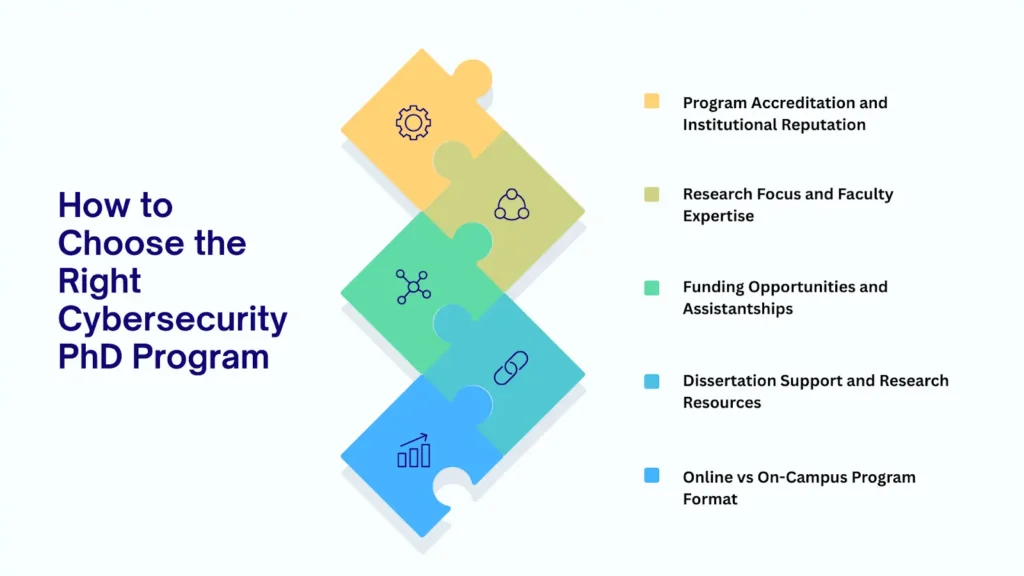
- Program Accreditation and Institutional Reputation
Accreditation ensures academic quality and recognition, while a strong university reputation can enhance the credibility of a doctorate in cybersecurity with employers and research institutions. - Research Focus and Faculty Expertise
Prospective students should review faculty research areas to ensure alignment with their interests. Strong mentorship is essential for dissertation success and long-term research development. - Funding Opportunities and Assistantships
Many doctoral programs offer financial support through fellowships, teaching assistantships, or research grants. Funding can significantly reduce the cost of earning a PhD in cybersecurity. - Dissertation Support and Research Resources
Access to research labs, cybersecurity centers, data resources, and academic support services plays a critical role in completing high-quality doctoral research. - Online vs. On-Campus Program Format
Students should consider whether an on-campus or online doctorate in cybersecurity best fits their learning style, professional commitments, and access to research opportunities.
Choosing the right doctoral program in cybersecurity can strongly influence research quality, completion time, and post-graduation career outcomes.
What Are the Career Opportunities After a Doctorate in Cybersecurity Programs?
Graduates with a doctorate in cybersecurity are qualified for some of the most advanced and influential roles in the cybersecurity field. Common career paths include:
| Career Role | Job Description | Annual Average Salary 2025 |
|---|---|---|
| Cybersecurity Researcher | Leads advanced research on cyber threats, secure systems, cryptography, and defense strategies. Often works in labs, R&D teams, or academic settings. | $147,276 |
| University Professor / Academic Researcher | Teaches cybersecurity courses, supervises doctoral research, and publishes original research. Positions focus on advancing academic knowledge in cyber defense. | $199,014 (varies widely by institution & tenure status) |
| Chief Information Security Officer (CISO) | Oversees an organization’s entire cybersecurity strategy, leads security teams, and manages risk and compliance programs at the highest level. | $384,715 |
| Cyber Policy Advisor | Advises government agencies or private sector organizations on cybersecurity policy, compliance, and national cyber strategy. | $129,475 |
| Security Architect | Designs and builds secure network and system architectures to protect against advanced threats and vulnerabilities. | $132,268 |
| Government or Defense Cyber Analyst | Works for defense or intelligence agencies to detect, analyze, and respond to cyber threats against critical infrastructure. | $94,668 |
Note: Salary figures are estimates and can vary considerably based on location, employer, level of experience, certifications, and specific industry demand. Geographic differences, employer type (private vs public), and specialization areas can significantly influence compensation.
A PhD in Cybersecurity prepares students for the highest level of expertise in one of today’s most critical and rapidly evolving fields. Whether pursued on campus or as a Doctorate in Cyber security online, this degree offers long-term value, professional credibility, and the opportunity to make a lasting impact in digital security.
FAQ’s
▶ Is a PhD in Cybersecurity worth it?
Yes. A PhD in cybersecurity is worth it for students aiming for research, academic, or senior leadership roles. It offers higher earning potential, long-term career stability, and influence in shaping cybersecurity policy and innovation.
▶ Is AI replacing cybersecurity?
No. Artificial intelligence enhances cybersecurity but does not replace it. Cybersecurity professionals are needed to design, manage, and secure AI-powered systems while addressing evolving threats.
▶ How many credits are required for a PhD in Cybersecurity?
Most doctoral programs in cybersecurity require a minimum of 60 credits, including coursework, research, and dissertation requirements. Exact credit requirements vary by institution and program structure.
▶ How long does it take to get a PhD in Cybersecurity?
A PhD in cybersecurity typically takes 4 to 6 years to complete, depending on enrollment status, research complexity, and dissertation progress.