

Top Master of Science in Data Science Programs
Top Master of Science in Data Science programs, costs, admission criteria, career paths, and salaries. Learn how an MS in Data Science can shape your future.
Ready to step into one of today’s most powerful and fast-growing tech fields? A Master of Science in Data Science can open doors to high-paying roles, new tools, and opportunities across every industry, from healthcare to finance to AI.
Introduction
If you have been thinking about building a career that blends problem-solving, technology, and innovation, a Master of Science in Data Science might be one of the smartest decisions you make.
The demand for data professionals is rising at an exceptional pace. According to the U.S. Bureau of Labor Statistics, jobs for data scientists are projected to grow 34% between 2024 and 2034, far faster than most other careers. Whether you are exploring master’s in data science, prefer the flexibility of an online data science master’s, or want to compare the best data science master’s programs, understanding your options is essential.
Today’s employers are seeking professionals who can turn complex data into solutions. Pursuing an MS in data science, whether on campus or through an online MS in data science program, gives you a competitive edge in a job market that continues to grow rapidly.
Affordable Data Science Master’s Programs
Choosing an affordable degree does not mean compromising on quality. Many accredited universities in the U.S. offer strong curricula, flexible online options, and industry-aligned coursework that help students gain essential skills.
| Rank | College/University Name | Location State | Type | Fee (In State) | Fee (Out-of-State) | Grad Rate (%) |
|---|---|---|---|---|---|---|
| 1 | Walden University | Minnesota | Online | $10,361 | – | 52% |
| 2 | Eastern University | Pennsylvania | Online | $14,220 | – | 56% |
| 3 | Bellevue University | Nebraska | Online | $11,880 | – | 56% |
| 4 | Monroe University | New York | Online & OnCampus | $13,058 | – | 57% |
| 5 | Regis University | Colorado | Online | $19,680 | – | 61% |
| 6 | University of North Dakota | North Dakota | Online & OnCampus | $11,963 | $17,944 | 63% |
| 7 | CUNY School of Professional Studies | New York | Online | $9,930 | $23,160 | NA |
When comparing affordable data science master’s programs, consider factors such as tuition, scholarships, program outcomes, and available financial aid.
Best Data Science Master’s Programs
Choosing the right university can shape your future career in data science. The best data science master’s programs offer strong faculty, industry-relevant hands-on training, advanced coursework in AI, and internship or capstone opportunities. Below is a curated list of top programs to which you can refer.
| Rank | College/University Name | Location State | Type | Fee (In State) | Fee (Out-of-State) | Grad Rate (%) |
|---|---|---|---|---|---|---|
| 1 | Harvard University | Massachusetts | Online | $55,656 | – | 97% |
| 4 | Columbia University | New York | OnCampus | $55,184 | – | 95% |
| 8 | Johns Hopkins University | Maryland | Online | $64,730 | – | 95% |
| 15 | University of Virginia | Virginia | Online | $19,884 | $33,304 | 95% |
| 7 | University of California-Berkeley | California | Online | $12,762 | $27,864 | 93% |
| 10 | University of Michigan | Michigan | OnCampus | $28,554 | $57,444 | 93% |
| 13 | Northeastern University | Massachusetts | Online | $28,786 | – | 90% |
| 11 | University of Maryland-College Park | Maryland | Online | $16,891 | $36,822 | 89% |
| 3 | The University of Texas at Austin | Texas | Online | $12,006 | $22,954 | 88% |
| 2 | University of Washington | Washington | OnCampus | $17,688 | $31,707 | 84% |
| 6 | University of Connecticut | Connecticut | Online&OnCampus | $19,512 | $41,424 | 84% |
| 16 | University of Miami | Florida | OnCampus | $45,540 | – | 84% |
| 14 | Willamette University | Oregon | Online&OnCampus | $50,084 | – | 73% |
| 5 | University of San Francisco | California | OnCampus | $29,880 | – | 71% |
| 17 | University of Arizona | Arizona | Online | $14,738 | $33,992 | 66% |
Why Pursue a Data Science Master’s Degree?
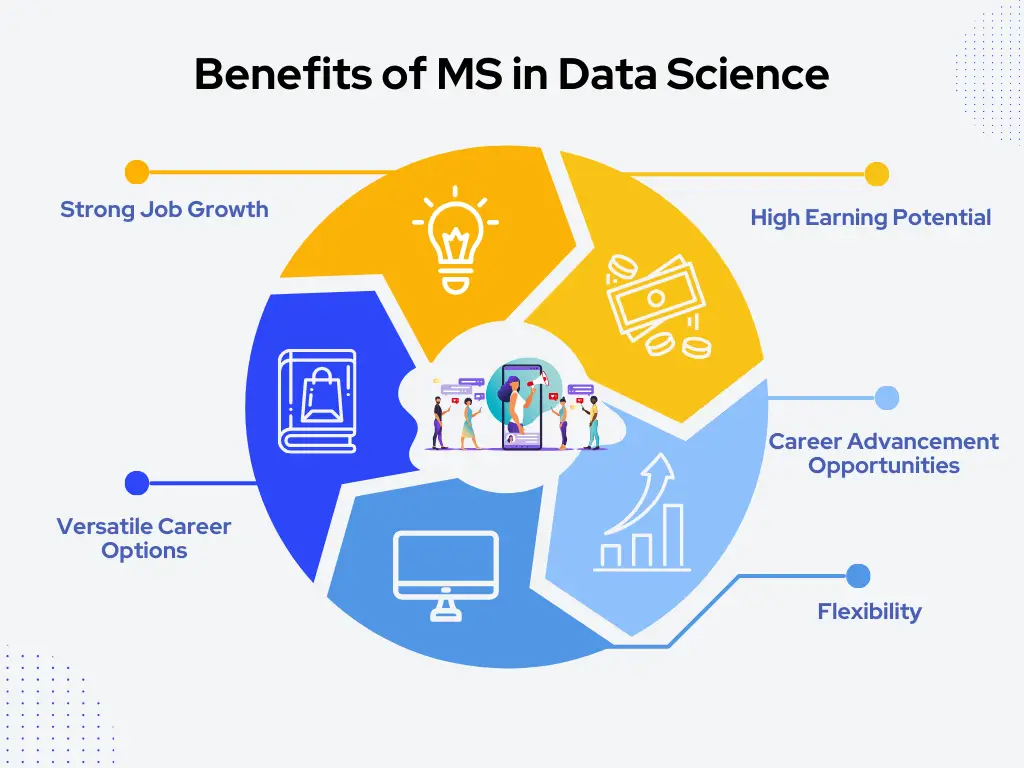
A Master of Science in Data Science equips students with the technical and analytical skills needed to work with large datasets and build predictive models. Here are the major benefits:
1. Strong Job Growth
The demand for skilled data professionals continues to rise as organizations increase investments in analytics, automation, and AI. Around 23,400 openings for data scientists are projected each year between 2024-2034. A master’s degree strengthens your competitiveness in this expanding job market by giving you deeper technical expertise than entry-level applicants.
2. High Earning Potential
Data science careers offer some of the strongest salary packages in the tech sector. Many graduates start their careers with good salaries, with a median annual income of $112,590 in 2024. The pay typically increases with specialization in areas like machine learning, AI engineering, or cloud analytics.
3. Versatile Career Options
One of the biggest advantages of pursuing data science masters programs is the flexibility to work across multiple industries. Data science skills are essential in fields like healthcare, finance, transportation, education, e-commerce, energy, cybersecurity, and even sports analytics.
4. Career Advancement Opportunities
A master’s degree opens doors to higher-level roles such as Lead Data Scientist, Machine Learning Engineer, AI Specialist, Director of Analytics, or Chief Data Officer. These positions require advanced knowledge of modeling techniques, data systems, and algorithm development skills typically gained through graduate-level training.
5. Flexibility
Many universities offer Master’s in data science online, making the degree accessible to working professionals or students seeking a self-paced learning environment. Online programs often include recorded lectures, virtual labs, and flexible submission schedules, allowing learners to balance work, education, and personal commitments.
Admission Criteria for MS in Data Science
Every university has its own requirements, but most Master of Science (MS) in Data Science programs including online options typically consider the following criteria:
1. Bachelor’s Degree: A degree in computer science, statistics, engineering, Mathematics, or related areas is preferred. Some universities accept students from non-technical backgrounds with bridge courses.
2. GPA Requirements: Most programs require a minimum GPA of 3.0 on a scale of 4.0 (varies by college).
3. GRE Scores: While some programs still require GRE scores, many universities have removed this requirement, especially for online data science master’s programs.
4. Programming and Math Skills: Students are generally expected to have basic knowledge of:
- Python or R
- Linear algebra
- Statistics
- Calculus
5. Professional Experience (Optional): Work experience in analytics, IT, or engineering can strengthen your application, especially for an online Master’s in data science.
6. Application Materials:
- Statement of purpose: This essay explains your academic background, career goals, and reasons for pursuing a Master of Science in Data Science.
- Letters of recommendation: These are typically written by professors or employers who can speak about your skills and academic performance.
- Resume or CV: Your resume should highlight relevant coursework, technical skills, internships, and professional experience to show your preparedness for advanced data science training.
How to Choose the Right Data Science Master’s Program?
With so many options, including campus-based degrees and master’s of data science online programs, it’s important to evaluate programs carefully. Here are a few things to consider before taking the call.
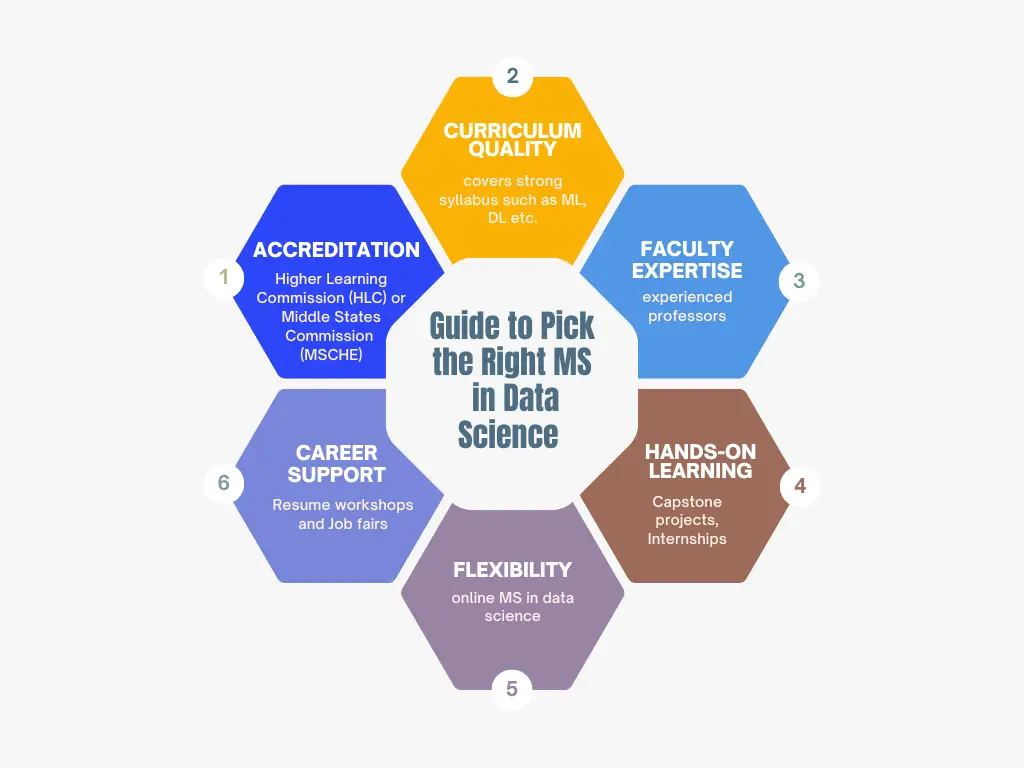
1. Accreditation
Ensure the university is accredited by a recognized body such as the Higher Learning Commission (HLC) or Middle States Commission on Higher Education (MSCHE).
2. Curriculum Quality
A strong curriculum should cover:
- Machine learning
- Deep learning
- Data mining
- Data visualization
- Cloud computing
- Big data tools like Spark and Hadoop
3. Faculty Expertise
Professors with experience in AI, research, and industry consulting are a major advantage.
4. Hands-On Learning
Look for programs that offer:
- Capstone projects
- Internships
- Real-world datasets
- Industry partnerships
5. Flexibility
If you are a working professional, an online Master’s in Data Science can offer greater flexibility through part-time study options.
6. Career Support
Check whether the university offers:
- Resume workshops
- Job fairs
- Employer connections
- Data science career coaching
What are the Career Opportunities After a Master of Science in Data Science
Graduates of Master’s in data science programs qualify for numerous high-demand roles, such as:
| CAREER ROLE | JOB DESCRIPTION | MEDIAN/AVERAGE SALARY |
|---|---|---|
| Data Scientist | Designs predictive models, analyzes complex datasets, and supports data-driven business strategies. | $112,590 per year (Median Salary, 2024 ) |
| Machine Learning Engineer | Builds and optimizes ML systems, automates analytical models, and advances AI innovation. | $181,566 per year (Average Salary, 2025) |
| Data Analyst | Interprets data patterns, prepares reports, and provides insights for organizational decisions. | $83,900 per year (Average Salary, 2025) |
| Business Intelligence Analyst | Builds scalable pipelines, manages data architectures, and supports analytics and ML operations. | $98,689 per year (Average Salary, 2025) |
| AI Specialist | Develops AI tools, NLP systems, and intelligent automation technologies. | $139,834 per year (Average Salary, 2025) |
| Quantitative Analyst | Uses statistical and mathematical models for financial risk assessment and investment strategies. | $143,367 per year (Average Salary, 2025) |
| Information Research Scientist | Conducts advanced research in AI, data science, healthcare, or government R&D labs. | $140,910 per year (Median Salary, 2024) |
Note: Salary ranges can vary based on several factors, including geographic location, industry demand, level of experience, and technical expertise.
Salary Trends in Data Science Careers
A degree such as an MS in data science can greatly influence earning potential in today’s analytics-driven job market. According to the BLS, the median annual salary for Data Scientists is $112,590 per year based on the most recent reporting period (2024).
- Beyond this median figure, salaries in data science continue to trend upward as organizations invest heavily in automation, AI, and cloud-based decision systems.
- Professionals with specialized skills in machine learning, deep learning, natural language processing, MLOps, or cloud platforms such as AWS and Azure often see higher-than-average compensation.
- Salary growth is also influenced by the type of employer. Technology firms, finance companies, healthcare systems, and consulting organizations often offer competitive packages due to the high reliance on predictive analytics and data-driven strategy.
- Startups, on the other hand, may offer lower base pay but compensate with additional benefits such as equity or performance bonuses.
- Geography remains one of the strongest factors affecting salary trends in data science. Regions like California, New York, Washington, Texas, and Massachusetts typically offer higher salaries because of increased demand for data talent and the presence of large tech companies.
- However, remote work opportunities have widened the salary landscape, enabling skilled professionals across the U.S. to access roles that were once limited to major tech hubs.
Conclusion
A Master of Science in Data Science gives students the tools they need to succeed in one of today’s most in-demand careers. Whether you’re considering an online Master’ in Data Science, or a campus-based program, the program should align with your goals, learning style, and professional aspirations. With strong job growth, competitive salaries, and opportunities across every industry, now is one of the best times to enter the field of data science.
FAQ’s
▶ Is doing a Master’s in Data Science worth it?
Yes. With strong job demand, high salaries, and opportunities across industries, a Master’s in Data Science is a valuable investment for students seeking long-term career growth.
▶ Is data science full of coding?
Coding is an important part of data science, especially in languages like Python and R. However, data science also includes statistics, problem-solving, data visualization, and communication.
▶ What are the 4 types of data in data science?
The four main types of data in data science are:
- Continuous: Includes measurable numeric values that can take any value within a range, such as height, weight, or temperature.
- Nominal: Categorizes data without any specific order, such as colors, names, or labels.
- Ordinal: Represents categories with a defined order or ranking, like rating scales or education levels.
- Discrete: Consists of countable numeric values, such as the number of students in a class.
▶ Will data science be replaced by AI?
AI will automate some tasks, but it cannot replace human-led decision-making, creativity, and strategic analysis. Instead, AI will expand the need for skilled data scientists.
▶ What is the hardest thing in data science?
The most challenging part is understanding complex data patterns and building accurate predictive models. Learning advanced mathematics and coding can also be challenging for beginners.