Explore PhD in Accounting programs, admissions, curriculum, costs, career paths, and salary outcomes. Learn if a doctorate in accounting is right for you.
Interested in shaping the future of accounting research, education, and policy? A PhD in Accounting offers a doctoral path for students who want to move beyond professional practice and engage deeply with research, analytics, and academic inquiry. It offers a structured route to developing expertise that shapes how accounting knowledge is applied at the highest level.
Introduction
With a shortage of doctorally qualified accounting professionals, there are strong opportunities for students who pursue a PhD in accounting as academic researchers and thought leaders. Research shows that the gap between demand and supply for accounting doctorates has intensified over the years, highlighting the strategic value of advanced doctoral credentials in this field.
A PhD in accounting is the highest academic qualification in the field. It is designed for students who want to conduct advanced research and influence the future of accounting practice and policy. Unlike professional accounting degrees, PhD accounting programs focus on theory-driven study, empirical research, and advanced data analysis. Through this article, you will gain a complete understanding of PhD in accounting programs, including admissions requirements, curriculum structure, career opportunities, and salary outcomes in the United States.
Best PhD in Accounting Programs
Choosing the best PhD in accounting programs requires careful evaluation of faculty expertise, research output, placement records, and funding opportunities. Top programs are often fully funded and provide strong academic mentorship. Below is a list of some accounting doctoral programs you can refer to:
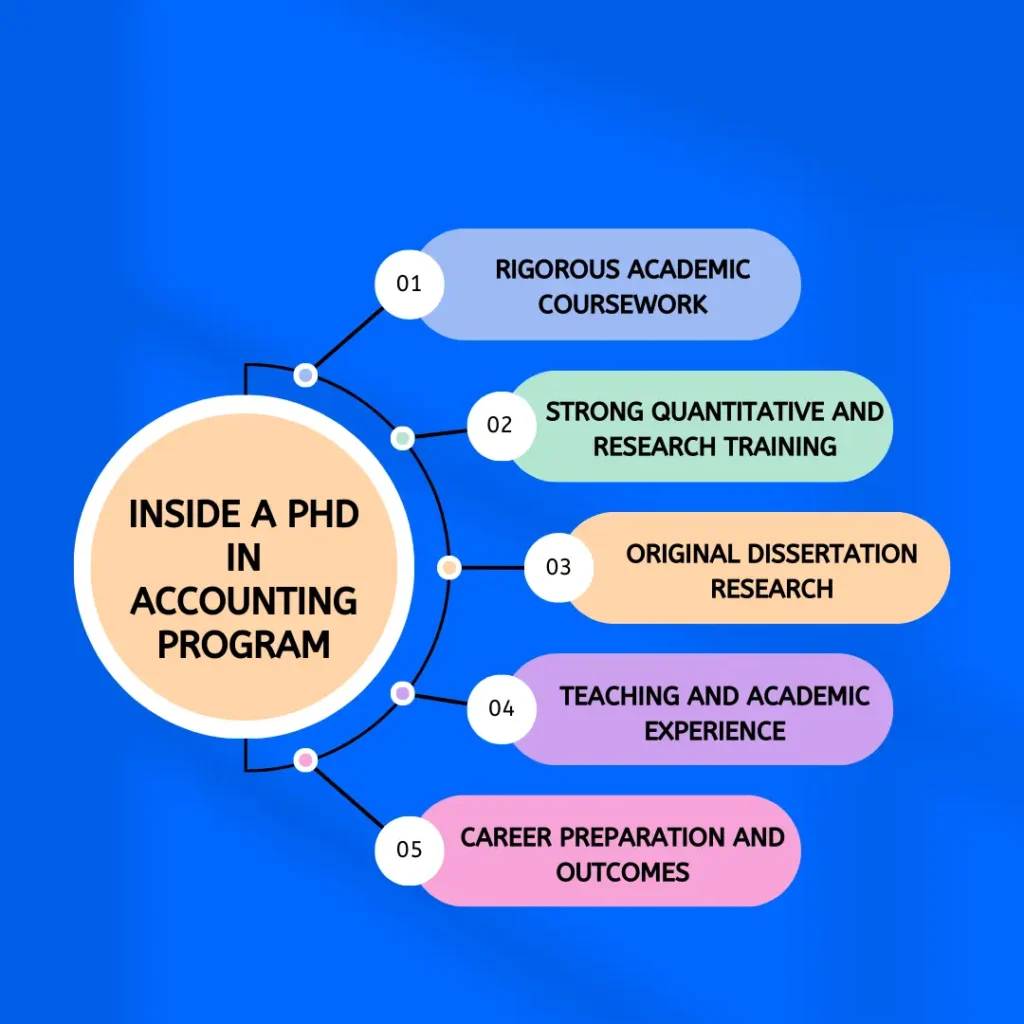
A doctorate in accounting is a research-focused program that typically takes 4 to 6 years to complete. The structure is designed to gradually move students from advanced coursework to independent research and professional academic preparation.
Rigorous Academic Coursework
Students complete advanced courses in financial accounting, auditing, taxation, and managerial accounting. These courses strengthen theoretical understanding and prepare students to analyze complex accounting issues.
Strong Quantitative and Research Training
Most programs emphasize econometrics, statistics, and data analysis. This training enables students to conduct high-quality empirical research using accounting and financial data.
Original Dissertation Research
A core component of the program is the completion of original research that culminates in a doctoral dissertation. This research contributes new insights to accounting theory, policy, or practice.
Teaching and Academic Experience
Many PhD in accounting programs include teaching assistantships or instructional roles. These opportunities help students develop classroom skills and academic teaching experience.
Career Preparation and Outcomes
Graduates are primarily prepared for tenure-track faculty positions at universities. Some also pursue research-focused roles in government agencies, policy institutions, and consulting organizations.
Admission Requirements for PhD in Accounting Programs
Admission into PhD in accounting programs is competitive and research-focused. While exact criteria vary by university, most programs look for strong academic preparation, quantitative ability, and clear research potential.
Strong academic records are essential, especially in quantitative subjects such as mathematics, statistics, or econometrics.
📊
GMAT or GRE Scores
Most PhD accounting programs require GMAT or GRE scores to assess quantitative and analytical readiness.
📝
Letters of Recommendation
Applicants must submit letters of recommendation, preferably from professors or research supervisors who can evaluate academic ability and research potential. Strong letters play a critical role in admissions decisions.
✍️
Statement of Purpose
The statement of purpose should clearly outline research interests, academic goals, and motivation for pursuing a doctorate in accounting.
📋
Resume or Curriculum Vitae (CV)
A detailed resume or CV should highlight academic achievements, research experience, publications (if any), teaching experience, and relevant professional background.
🌐
English Language Proficiency
International and domestic applicants applying to PhD programs in accounting in the USA may need to demonstrate English proficiency through exams such as TOEFL or IELTS.
Popular Accounting PhD Courses
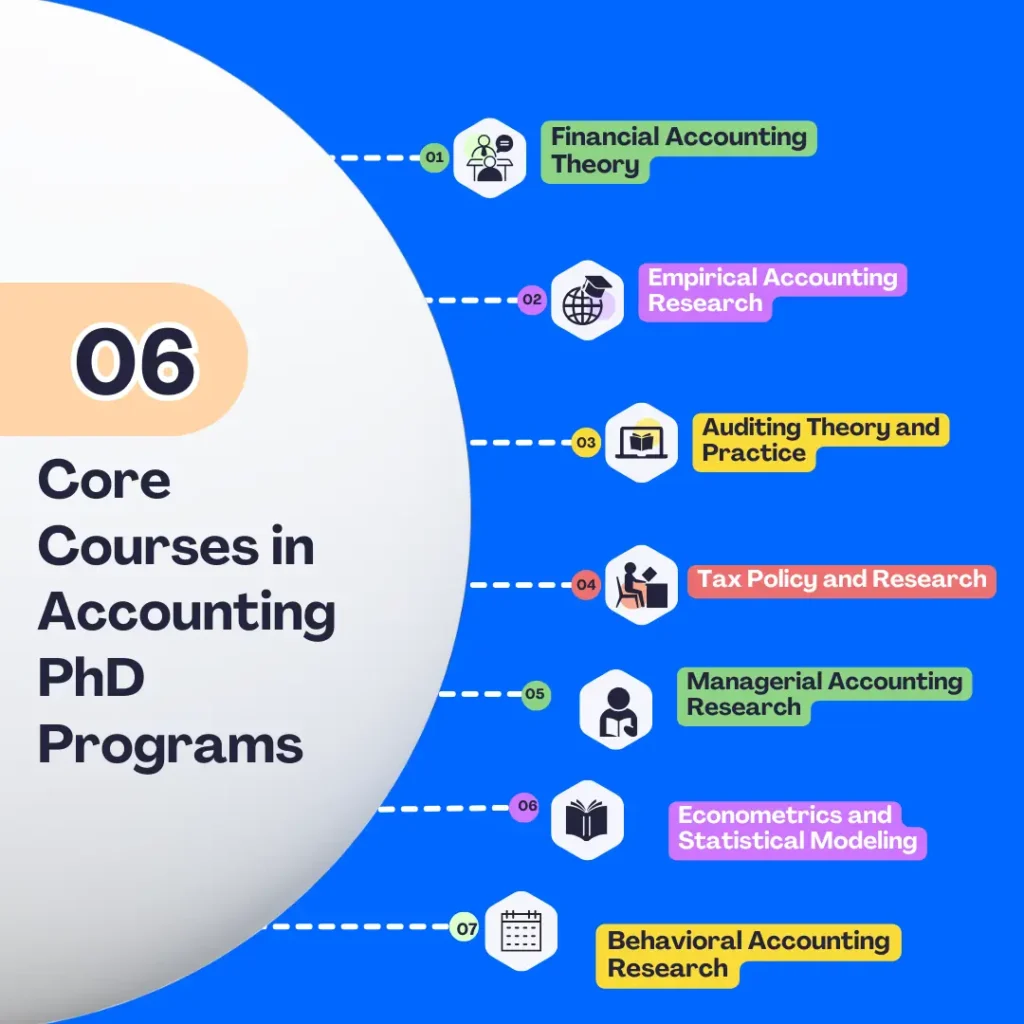
The curriculum in PhD accounting programs is designed to develop advanced theoretical knowledge, strong analytical skills, and independent research capability. Coursework typically begins in the early years of the program and provides the foundation needed for high-quality academic research.
Financial Accounting Theory
This course focuses on the conceptual frameworks that govern financial reporting. Students examine accounting standards, disclosure practices, and the economic consequences of financial reporting decisions.
Empirical Accounting Research
Students learn how to design and conduct empirical studies using real-world accounting and financial data. Emphasis is placed on research design, hypothesis testing, and data interpretation.
Auditing Theory and Practice
This course explores audit risk, assurance services, and regulatory frameworks. It prepares students to analyze audit quality, auditor behavior, and the effectiveness of audit standards.
Tax Policy and Research
Students study taxation theory, tax compliance, and the impact of tax policy on individuals and organizations. Research methods related to tax data and policy evaluation are also covered.
Managerial Accounting Research
This subject focuses on internal reporting, performance measurement, and managerial decision-making. Students analyze how accounting information influences organizational behavior and strategy.
Econometrics and Statistical Modeling
Advanced training in econometrics equips students with quantitative tools for accounting research. Topics often include regression analysis, panel data models, and causal inference techniques.
Behavioral Accounting Research
This course examines how psychological and behavioral factors affect accounting decisions. Students explore judgment, decision-making, and ethical considerations in accounting contexts.
As students advance in the program, formal coursework gradually transitions into independent research, comprehensive exams, and doctoral dissertation development, allowing students to specialize in their chosen area of accounting research.
How to Select the Right Accounting Doctoral Degree
Choosing the right PhD in accounting program is essential for long-term academic success and research productivity. Students should carefully evaluate programs based on faculty strength, funding, and career outcomes.
Faculty Research Alignment
Match faculty research areas with your specialization
Look for active publishing and strong mentorship
Graduate Placement and Publications
Review recent graduate placement outcomes
Strong programs place students in research or faculty roles
Funding and Financial Support
Most programs offer full tuition coverage
Annual stipends and assistantships are common
Teaching and Research Support
Teaching assistantships build academic experience
Access to research tools and databases is essential
Program Reputation and Accreditation
Accreditation strengthens degree credibility
Reputation can influence academic hiring
Online vs. On-Campus Format
Fully online options are limited
On-campus programs offer better research collaboration
Accounting Jobs and Salaries: PhD in Accounting in the USA
Graduates with a PhD in accounting qualify for advanced, research-driven, and leadership roles across academia, government, and industry. The table below highlights common career paths, core responsibilities, and typical salary outcomes.
Career Role
Job Description
Median / Average Annual Salary
Accounting Professor / Faculty Member
Teach undergraduate and graduate accounting courses, conduct academic research, and publish in peer-reviewed journals.
Conduct empirical and theoretical research in accounting, financial reporting, auditing, or taxation. Often employed by universities, think tanks, or research institutions.
Lead research initiatives related to accounting standards, compliance, and financial transparency within academic, regulatory, or corporate environments.
Note:Salary figures may vary based on geographic location, institution type, years of experience, research specialization, and industry demand.
A doctorate in accounting is an excellent pathway for students committed to research, teaching, and thought leadership in the accounting field. With strong funding, high academic prestige, and meaningful career outcomes, PhD accounting programs continue to attract ambitious and research-driven students.
FAQ's
▶ How Much Do Accounting PhD Programs Cost?
Most PhD in accounting programs in the United States are fully funded, meaning students typically do not pay tuition and instead receive an annual stipend to cover living expenses. For unfunded or partially funded programs, annual tuition can range from approximately $20,000 to $50,000, depending on the institution. Over the full duration of the program, the total cost of a PhD in accounting can exceed $100,000, which is why funding availability is a critical factor when evaluating doctoral programs.
▶ Is a PhD in accounting worth it?
Yes. The accounting field continues to show steady demand over the decade, reflecting the ongoing need for advanced accounting expertise. A doctorate in accounting is especially valuable for students pursuing academic, research, or policy-focused careers. It offers strong job stability, intellectual independence, and long-term earning potential in universities, research institutions, and public organizations.
▶Which PhD is most in demand?
According to current global demand trends, the PhD in Computer Science and Artificial Intelligence (AI) tops the list of most in-demand doctoral degrees due to rapid advancements in automation, machine learning, and data-driven decision-making. Following closely are PhD programs in Analytics, Data Science, and PhD degrees in Management and Business-related fields, which are increasingly sought after for specialized research and leadership roles across industries.
▶ How many years is a Doctorate in Accounting?
A PhD in accounting typically takes 4 to 6 years to complete. The timeline depends on coursework progression, research milestones, and dissertation completion.
Cookie Consent
We use cookies to improve your experience on our site. By using our site, you consent to cookies.