Compare data analytics bachelor’s degrees, explore online options, admission requirements, career paths, job outlook, and salary trends with the latest data.
Ready to build a career where data shapes real-world decisions? A data analytics bachelor's degree opens high-demand roles across every industry. Whether you dream of working in tech, healthcare, finance, or government, this degree can be your launchpad.
Indroduction
Today’s world runs on data, and organizations rely on skilled analysts to turn information into insights. Earning a data analytics bachelor's degree gives you the technical, analytical, and problem-solving skills needed in fast-growing fields. Insights from the U.S. Bureau of Labor Statistics indicate that employment for data-focused roles is expected to grow 35% from 2024 to 2034, faster than the average for all occupations.
If you are exploring a bachelor's in data analytics, this subject page offers a comprehensive starting point. You will find program types, job options, salaries, and what to expect, everything you need to choose the right path with confidence.
Affordable Colleges for Bachelor's In Data Analytics
Finding an affordable bachelor’s in data analytics allows students to gain high-value skills without long-term financial stress.
If affordability is your top priority, several accredited colleges offer quality programs at lower tuition rates. These institutions provide strong data analytics programs while keeping costs manageable for students and families.
Students seeking a challenging academic experience, an advanced curriculum, and strong job placement outcomes can explore top-rated programs across the US.
Many universities stand out for their hands-on learning, industry connections, and flexible formats. These programs are ideal for students who want a blend of theory, technology, and real-world application.
How Long Does It Take to Get a Data Analytics Bachelor's Degree?
A traditional bachelor's degree in data analytics typically takes four years to complete. However, the duration may vary based on program structure:
Full-time programs: 4 years → Students follow a standard semester schedule, allowing steady progress through all major and elective requirements.
Accelerated programs: 2.5-3 years (ideal for motivated learners) → These programs move at a faster pace, helping students graduate sooner by taking heavier course loads or year-round classes.
Part-time or online formats: 4-6 years → Learners take fewer courses each term, making this option suitable for those who need flexibility due to work or personal commitments.
Transfer students: may finish sooner if previous credits apply → Accepted transfer credits reduce the number of required courses, allowing students to complete the degree in a shorter timeframe.
Many schools offer a data analytics bachelor's degree online, which provides additional flexibility for working students or those who prefer remote learning. Online programs also allow learners to progress at their own pace. Some universities provide competency-based pathways that allow students to advance quickly by demonstrating mastery.
How to Choose the Right Data Analytics Bachelor's Degree Online?
Selecting the best data analytics bachelor’s degree online requires careful evaluation. Here are key factors to consider:
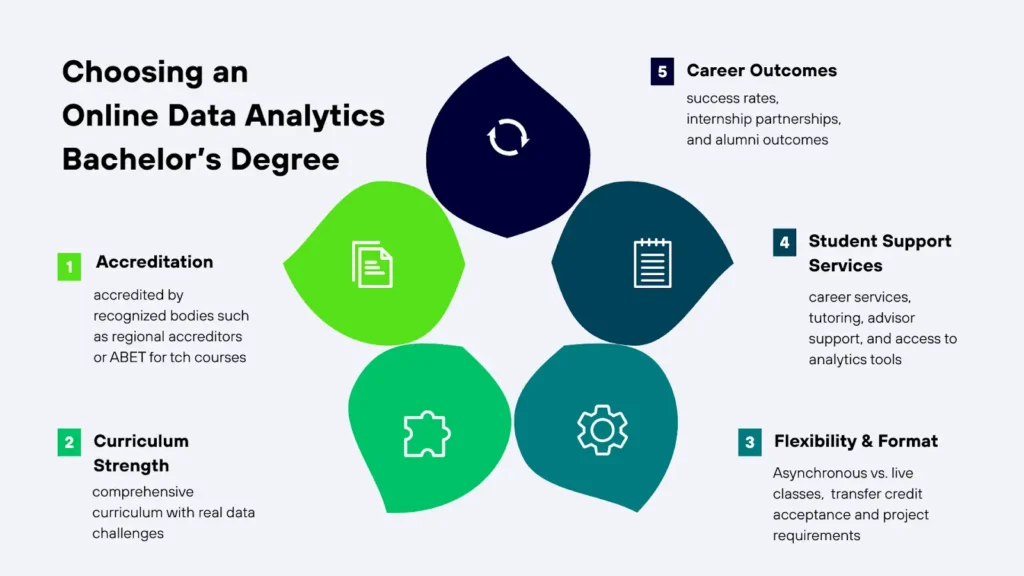
1. Accreditation
Choose programs accredited by recognized bodies such as regional accreditors or ABET (Accreditation Board for Engineering and Technology, for tech-related tracks). Accreditation ensures educational quality and improves employability.
2. Curriculum Strength
A strong bachelor’s degree in data analytics should include:
Data mining
Business analytics
Predictive modeling
SQL and databases
Python or R
Data visualization
Machine learning fundamentals
A comprehensive curriculum helps students build both technical and analytical skills needed for real-world data challenges.
3. Flexibility & Format
Online learners should check for:
Asynchronous vs. live classes
Multiple start dates
Transfer credit acceptance
Internship or project requirements
4. Student Support Services
Look for career services, tutoring, advisor support, and access to analytics tools. Strong support services ensure students receive academic guidance and career preparation throughout their program.
5. Career Outcomes
Research graduate success rates, internship partnerships, and alumni outcomes. Understanding career outcomes helps students choose programs that lead to strong employment prospects and industry connections.
Admission Requirements for a Bachelor's Degree in Data Analytics
Admission requirements for a bachelor’s degree in data analytics may differ by institution, most colleges follow a similar set of guidelines to ensure students are prepared for the academic rigor of the program. Below are the common requirements and what they typically include:
High school diploma or equivalent Students must have completed high school or earned a recognized equivalent, such as a GED to demonstrate readiness for college-level coursework and foundational subjects like math and English.
Minimum GPA requirements (typically 2.5-3.0) Many colleges set a minimum GPA to assess academic preparedness. A stronger GPA can improve admission chances, especially at competitive institutions.
SAT/ACT scores (increasingly optional) Standardized test scores may be accepted, but are optional at most schools. Students who submit scores may use them to strengthen their application, particularly in math-related sections.
Personal statement or essay Applicants are often asked to write an essay explaining their interest in data analytics, career goals, or relevant experiences.
Letters of recommendation (optional at some colleges) Some programs request letters from teachers, counselors, or employers. These recommendations highlight academic strengths, work ethic, and potential for success in the program.
Prerequisite coursework Certain colleges expect applicants to have completed introductory classes in subjects such as algebra, statistics, or computer science.
Additional requirements for online programs Some programs offering a data analytics bachelor’s degree online may ask for proof of technical preparedness, such as basic computer skills, or require completion of foundational math and programming courses.
Overall, while requirements differ by institution, students should review each college’s expectations carefully and prepare materials early to strengthen their application
What Can You Do With a Data Analytics Bachelor's Degree?
Earning a data analytics bachelor’s degree opens doors to a wide range of career paths across industries that rely heavily on data-driven decision-making. Because nearly every organization collects and uses data, graduates can work in both technical and business-focused environments. This degree prepares students to interpret complex information, identify trends, and support strategic planning, making them valuable contributors in many professional settings.
You can work in sectors such as:
Healthcare Graduates help hospitals and healthcare systems analyze patient data, improve treatment outcomes, reduce operating costs, and support public health decisions.
Finance Financial institutions rely on analysts to assess market trends, evaluate risks, detect fraud, and guide investment strategies using quantitative data.
Government Public agencies use data analytics to improve community planning, evaluate social programs, enhance cybersecurity, and streamline public services.
Education Schools and universities use analysts to study student performance metrics, optimize budgeting, and improve learning programs through evidence-based insights.
Technology Tech companies rely on analytical skills for product development, user behavior analysis, cloud-based data management, and performance optimization.
Retail Retailers use data analytics to predict consumer behavior, personalize marketing campaigns, improve supply chain efficiency, and increase sales performance.
Manufacturing Manufacturers apply analytics to quality control, equipment maintenance, production forecasting, and operational efficiency.
These diverse industries show that data analytics is not limited to tech; organizations everywhere depend on trained professionals who understand how to convert information into actionable insights.
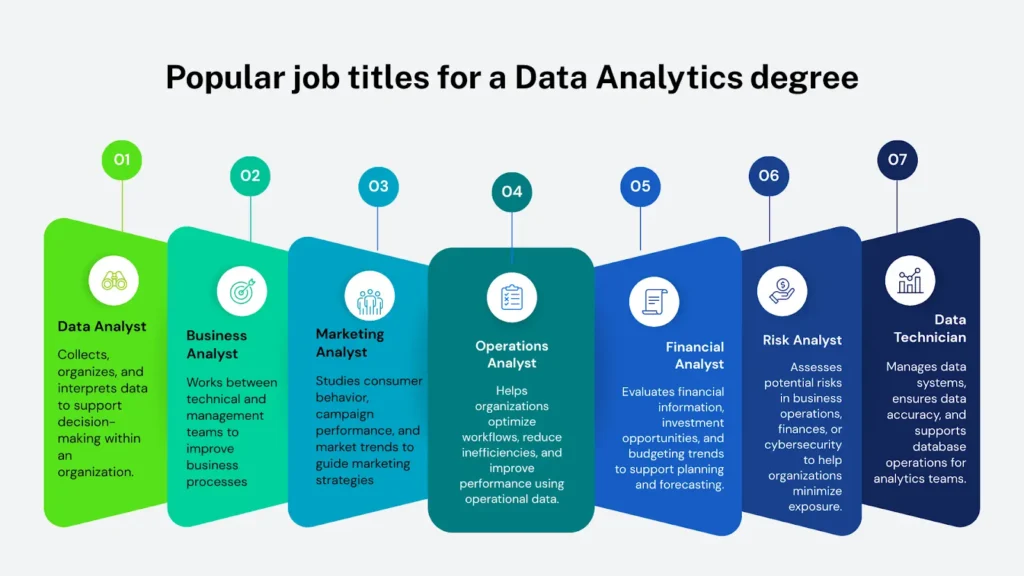
Graduates with a bachelor’s degree in data analytics commonly pursue roles such as:
These roles can be found across both public and private sectors, giving graduates flexibility to choose industries that match their interests and career goals.
Beyond these traditional roles and industries, the way students earn their degree is also shaping career outcomes. With more colleges offering flexible learning formats, many students now pursue analytics careers through online education. The next section explores how a data analytics bachelor’s degree online specifically prepares graduates for today’s evolving digital workforce.
Career Opportunities with a Data Analytics Bachelor's Degree Online
Completing a bachelor’s degree in data analytics or an online data analytics bachelor’s degree opens the door to high-growth careers. Employers increasingly value data skills as organizations digitize operations.
Career Role
Typical Job Description
Median / Annual Salary (USD)
Data Scientist
Uses statistical analysis, machine learning, and programming to interpret complex data, build predictive models, and generate insights to guide businessdecisions.
Gathers, processes, and analyzes business data (sales, operations, customer behavior) to support strategic decision-making and reporting to stakeholders.
Applies mathematical modeling, statistical analysis, and optimization techniques to help organizations improve efficiency, reduce costs, and make data-driven operational decisions.
Management / Analytics Consultant(related to data/analysis consulting)
Advises organizations on business operations, performance improvements, and data strategy, and helps implement analytical solutions or process optimizations.
Collects, cleans, and analyzes datasets; prepares reports and visualizations; supports teams in interpreting data to guide decisions in marketing, finance, and operations.
Note: “Database Specialist”, “Junior Data Engineer”, or similar roles often fall under broader categories such as Data Scientist, Data Engineer, or Analytics Consultant in public data, so exact median figures vary and depend on employer, location, and specific responsibilities.
FAQ's
▶ What is a Bachelor's in data analytics?
A bachelor's in data analytics is a four-year undergraduate degree that teaches students how to collect, analyze, interpret, and present data. The program combines statistics, computer science, and business applications to prepare graduates for roles in analytics and decision-making.
▶ Do you need math to get into Data analytics?
Yes. Math is an essential part of a data analytics bachelor's degree. Students need foundational skills in:
Statistics
Algebra
Probability
Some advanced courses may include calculus or linear algebra. However, strong analytical thinking is just as important as math skills.
▶ What degree is best for a data analyst?
A bachelor's degree in data analytics is one of the best pathways because it is specifically designed for careers in data analysis. Other suitable degrees include:
Computer science
Statistics
Mathematics
Business analytics
Information systems
However, a bachelor's in data analytics offers the most focused preparation for data analysis roles.
▶ How hard is a data analytics job?
A job in data analytics can be challenging but rewarding. It requires problem-solving, attention to detail, and the ability to work with large datasets. Tools like Excel, SQL, Python, and visualization platforms make the process manageable. With practice and training through a data analytics bachelor's degree, most students find the work highly engaging.
▶ Which is the highest paying job for a bachelor’s in data analytics?
Some of the highest-paying roles for graduates with a data analytics bachelor’s degree include:
Data Scientist
Machine Learning Analyst
Business Intelligence Analyst
Quantitative Analyst
Data scientists, for example, earn a median salary above $100,000 per year, depending on experience and industry.
Cookie Consent
We use cookies to improve your experience on our site. By using our site, you consent to cookies.