

Best Master’s in Finance Programs
Explore the best Master’s in Finance programs, admission requirements, career outlook, costs, and salary data. Find affordable and top MS in Finance options.
Getting a Master’s in Finance can open doors to high-growth careers in banking, investment management, and corporate finance. This guide helps you understand the best master’s in finance programs and career outcomes, helping you choose the most rewarding finance degree with confidence.
Introduction
A Master’s in Finance is one of the most sought-after graduate degrees for students who want to build strong careers in financial analysis, investment banking, corporate finance, or fintech.
The demand for finance professionals continues to rise. According to the U.S. Bureau of Labor Statistics (BLS), employment in business and financial occupations is projected to grow faster than average from 2024 to 2034, with about 942,500 openings expected each year on average due to growth and replacement needs.
Whether you are trying to find affordable Master’s MS in Finance programs or looking for the best Master’s in Finance programs with a strong reputation, understanding the program structure, curriculum, cost, and career outcomes can help you make the right choice.
Because of this strong demand, the finance master’s degree has become a top choice for students seeking advanced knowledge in finance.
Affordable Master’s in Finance Programs
Choosing an affordable MS in finance program that can make graduate school more accessible without compromising on education quality. These programs are known for offering strong value through reasonable tuition, flexible learning options, and solid career outcomes.
Here is a list of budget-friendly programs you can explore:
| Rank | College/University Name | Location State | Type | Fee (In State) | Fee (Out-of-State) | Grad Rate (%) |
|---|---|---|---|---|---|---|
| 1 | Penn State World Campus | Pennsylvania | Online | TuitionFee($24,406) | – | 34% |
| 2 | Southern New Hampshire University | New Hampshire | Online&OnCampus | Tuition Fee($19,467) | – | 45% |
| 3 | University of The Cumberlands | Kentucky | Online | TuitionFee($4,260) | – | 46% |
| 4 | Georgia State University | Georgia | OnCampus | InState($7,164) | OutState($22,662) | 54% |
| 5 | Middle Tennessee State University | Tennessee | Online | InState($9,648) | OutState($26,694) | 54% |
| 6 | University of Michigan-Dearborn | Michigan | Online&OnCampus | InState($15,556) | OutState($28,160) | 57% |
| 7 | University of Illinois Chicago | Illinois | Online&OnCampus | InState($14,390) | OutState($24,588) | 60% |
| 8 | The University of Tampa | Florida | OnCampus | TuitionFee($12,762) | – | 62% |
| 9 | University of Nebraska-Lincoln | Nebraska | Online | InState($6,318) | OutState($18,468) | 66% |
| 10 | New England College | New Hampshire | Online | TuitionFee($13,523) | – | 31% |
| 11 | Texas A&M University Corpus Christi | Texas | Online&OnCampus | InState($3,610) | OutState($11,751) | 34% |
| 12 | Louisiana State University | Louisiana | OnCampus | NA | NA | 36% |
| 13 | Western Illinois University | Illinois | OnCampus | TuitionFee($9,133) | – | 45% |
| 14 | University of Michigan Flint | Michigan | Online&OnCampus | InState($13,891) | OutState($20,808) | 45% |
| 15 | University Of Bridgeport | Connecticut | OnCampus | TuitionFee($19,096) | – | 48% |
| 16 | University of Tennessee at Chattanooga | Tennessee | Online&OnCampus | InState($9,120) | OutState($17,184) | 53% |
| 17 | Arkansas State University | Arkansas | Online&OnCampus | InState($6,858) | OutState($12,564) | 55% |
| 18 | Washington University of Science and Technology | Virginia | Online&OnCampus | TuitionFee($11,880) | – | 55% |
| 19 | Texas State University | Texas | OnCampus | InState($6,432) | OutState($13,812) | 56% |
| 20 | University Of New Haven | Connecticut | Online&OnCampus | TuitionFee($19,656) | – | 59% |
| 21 | University of Illinois at Springfield | Illinois | Online&OnCampus | InState($8,838) | OutState($16,415) | 61% |
| 22 | Washington State University | Washington | Online | InState($13,055) | OutState($28,677) | 62% |
| 23 | University of Wisconsin White Water | Wisconsin | Online | InState($9,256) | OutState($20,316) | 64% |
| 24 | University of Utah | Utah | Online | InState($7,610) | OutState($26,869) | 64% |
| 25 | Florida Atlantic University | Florida | Online | InState($5,467) | OutState($16,695) | 64% |
| 26 | Colorado State University | Colorado | OnCampus | TuitionFee($12,150) | – | NA |
| 27 | Arizona State University | District of Columbia | Online&OnCampus | NA | NA | NA |
Top Master’s in Finance Programs
If you are looking for high-ranking institutions with strong reputations, world-class faculty, and excellent networking opportunities, these top master’s programs are widely recognized in the field of finance. Below is a starting point for the top options you can consider:
| Rank | College/University Name | Location State | Type | Fee (In State) | Fee (Out-of-State) | Grad Rate (%) |
|---|---|---|---|---|---|---|
| 1 | Johns Hopkins University | Maryland | Online&OnCampus | TuitionFee($62,840) | – | 95% |
| 2 | University of Southern California | California | OnCampus | TuitionFee($66,640) | – | 92% |
| 3 | Emory University | Georgia | Online | TuitionFee($46,800) | – | 92% |
| 4 | Boston College | Massachusetts | OnCampus | TuitionFee($35,784) | – | 91% |
| 5 | Tulane University | Louisiana | OnCampus | TutionFee($63,814) | – | 89% |
| 6 | University of Maryland | Maryland | OnCampus | InState($16,560) | OutState($36,100) | 89% |
| 7 | The University of Texas at Austin | Texas | OnCampus | InState($12,012) | OutState($22,954) | 88% |
| 8 | University of Minnesota | Minnesota | Online | InState($19,116) | OutState($29,580) | 85% |
| 9 | University of Illinois Urbana-Champaign | Illinois | Online&OnCampus | InState($15,545) | OutState($30,348) | 85% |
| 10 | Michigan State University | Michigan | OnCampus | InState($20,808) | OutState($40,884) | 82% |
| 11 | University of California | California | OnCampus | InState($12,264) | OutState($27,366) | 77% |
| 12 | Florida Internation University | Florida | Online | InState($9,119) | OutState($21,600) | 74% |
| 13 | University of Massachusetts Lowell | Massachusetts | Online&OnCampus | InState($15,330) | OutState($27,706) | 70% |
| 14 | St. John’s University-New York | New York | Online&OnCampus | TuitionFee($46,800) | – | 68% |
| 15 | Wayne State University | Michigan | OnCampus | InState($18,301) | OutState($39,639) | 57% |
| 16 | Northeastern University | Massachusetts | OnCampus | TuitionFee($28,786) | – | 90% |
| 17 | Tulane University | Louisiana | OnCampus | TuitionFee($67,004) | – | 89% |
| 18 | University of Massachusetts Amherst | Massachusetts | OnCampus | InState($15,091) | OutState($33,407) | 83% |
| 19 | University of Dayton | Ohio | OnCampus | TuitionFee($19,530) | – | 81% |
| 20 | Saint Louis University | Missouri | OnCampus | TuitionFee($24,660) | – | 80% |
| 21 | DeVry University | Arizona | OnCampus | TuitionFee($9,312) | – | 80% |
| 22 | American University | District of Columbia | OnCampus | TuitionFee($35,817) | – | 78% |
| 23 | University of Denver | Colorado | OnCampus | TuitionFee($40,885) | – | 78% |
| 24 | Webster University | Missouri | Online&OnCampus | TuitionFee($13,536) | – | 77% |
| 25 | University of New Hampshire | New Hampshire | OnCampus | InState($14,520) | OutState($28,500) | 76% |
| 26 | University of Oklahoma | Oklahoma | Online&OnCampus | InState($9,174) | OutState($25,963) | 75% |
| 27 | Sacred Heart University | Connecticut | OnCampus | TuitionFee($34,394) | – | 74% |
| 28 | New Jersey Institute of Technology | New Jersey | OnCampus | InState($23,570) | OutState($34,850) | 73% |
| 29 | Fairleigh Dickinson University | New Jersey | OnCampus | TuitionFee($24,588) | – | 72% |
| 30 | Rochester Institute of Technology | New York | OnCampus | TuitionFee($59,102) | – | 71% |
| 31 | DePaul University | Illinois | OnCampus | TuitionFee($22,959) | – | 70% |
| 32 | George Mason University | Virginia | Online&OnCampus | InState($14,136) | OutState($36,480) | 69% |
| 33 | University of the Pacific | California | Online&OnCampus | TuitionFee($54,512) | – | 68% |
| 34 | Hofstra University | New York | Online&OnCampus | TuitionFee($30,510) | – | 67% |
| 35 | Hult International Business School | Massachusetts | OnCampus | TuitionFee($54,700) | – | 66% |
| 36 | Northwood University | Michigan | Online&OnCampus | TuitionFee($37,980) | – | 61% |
| 37 | Suffolk University | Massachusetts | Online&OnCampus | TuitionFee($37,944) | – | 60% |
| 38 | University of Massachusetts Boston | Massachusetts | OnCampus | InState($19,850) | OutState($38,746) | 51% |
Admission Requirements For a Master’s in Finance
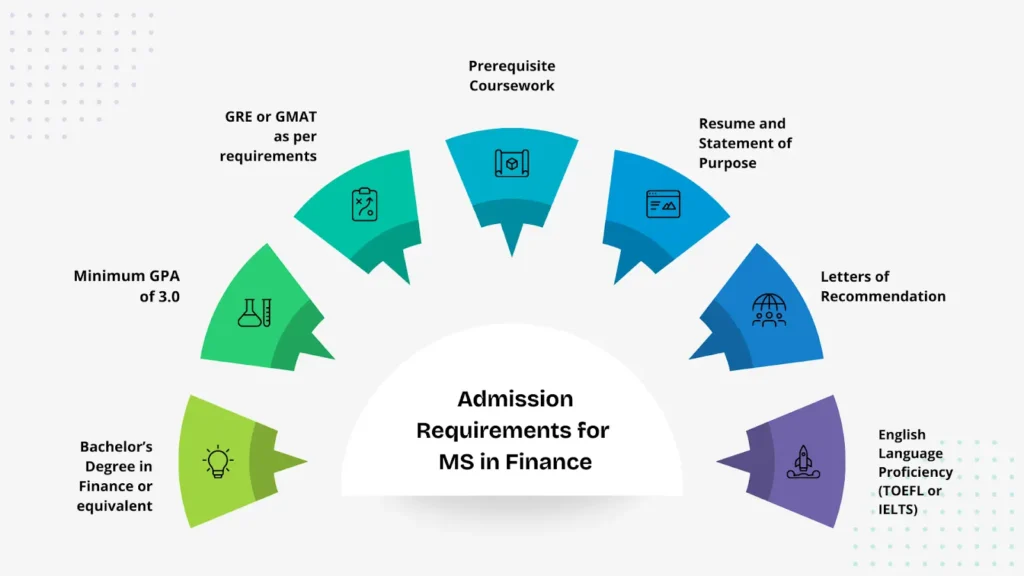
Most universities offering an MS in Finance have similar admission requirements. While specific standards vary, students can generally expect the following:
1. Bachelor’s Degree
A bachelor’s degree in finance or equivalent from an accredited institution is required. Most programs accept students from business, economics, mathematics, engineering, and related fields.
2. GPA Requirement
A minimum GPA of 3.0 is common, although competitive programs may expect higher academic performance.
3. GRE or GMAT (Varies by Program)
Some universities require the GRE or GMAT, while many now offer test-optional admissions. Applicants should review specific college guidelines.
4. Prerequisite Coursework
Most programs expect prior coursework in:
- Statistics
- Economics
- Accounting
- Calculus
Some universities may also require classes in financial management or linear algebra. Applicants lacking these prerequisites may need to complete bridge courses before enrolling.
5. Resume and Statement of Purpose
A resume outlining academic and professional experience is essential. Students must also submit a statement of purpose explaining why they want to pursue a master’s degree in finance.
6. Letters of Recommendation
Typically, two to three academic or professional recommendations are required. Strong recommendations often come from professors, supervisors, or mentors who can speak to the applicant’s abilities and work ethic.
7. English Language Proficiency (International Students)
TOEFL or IELTS scores may be required for non-native English speakers. Some institutions also accept alternative assessments, such as the Duolingo English Test, or offer waivers for students who have completed prior education in English-speaking institutions.
How long does a Master’s in Finance Degree take to complete?
A Master’s in Finance generally takes 12 to 24 months to finish. The duration depends on the program structure and whether the student attends full-time or part-time.
Typical Program Length Options
- 1-year accelerated programs: Ideal for students who want to enter the workforce quickly.
- 18-month programs: Balanced option offering extended coursework and internships.
- 2-year programs: Often include advanced specializations, research projects, or capstone work.
Many universities also offer online MS in Finance programs for students seeking flexible schedules.
How much does a Master’s degree in Finance cost?
The cost of a Master’s in Finance varies widely based on the school, location, and whether it is a public or private university. The typical range lies between $44,640 and $71,140.
Average Cost Breakdown
- Public universities: $20,000 – $36,000 total tuition
- Private universities: $35,000 – $70,000
The National Center for Education Statistics(NCES) says that the average graduate tuition at public institutions is significantly lower than at private institutions.
Additional Expenses
- Textbooks and materials
- Campus fees
- Technology fees (for online programs)
- Housing and living expenses
To reduce costs, students can explore scholarships, assistantships, employer tuition support, and financial aid options.
Job Outlook and Salary for Master’s in Finance Programs
Graduates with a master’s degree in finance can pursue high-growth and high-paying jobs in various finance sectors.
According to the U.S. Bureau of Labor Statistics (BLS), employment in financial occupations is projected to grow between 6% and 10% from2024 to 2034, which is faster than the average for all occupations. Below is a table featuring career roles for graduates with a Master’s in Finance, along with job descriptions and annual median salaries.
| CAREER ROLE | JOB DESCRIPTION | AVERAGE ANNUAL MEDIAN SALARY |
|---|---|---|
| Financial Analyst | Analyze financial statements, market trends, and investment opportunities. Prepare reports and make recommendations to individuals or companies. | $101,910 (2024) |
| Investment Banking Associate | Support IPOs, mergers & acquisitions, and corporate finance deals. Build financial models and pitch books for clients. | $99,484 (2025) |
| Corporate Finance Manager | Oversee a company’s budgeting, forecasting, and capital structure. Advise senior leadership on strategic financial decisions (e.g., growth, acquisitions). | $118,362 (2025) |
| Risk Analyst / Financial Risk Specialist | Identify and quantify financial risks (market, credit, operational) for firms. Develop mitigation strategies and monitor risk exposures. | $90,181 (2025) |
| Financial Advisor | Provide financial planning and investment advice to individuals or businesses. Recommend retirement, estate planning, insurance, and investment strategies. | $71,465 (2025) |
| Portfolio Manager | Manage investment portfolios on behalf of clients or funds. Make asset allocation decisions, monitor performance, and rebalance holdings. | $104,150 (2025) |
| Quantitative Analyst (“Quant”) | Use advanced mathematical models and algorithmic techniques to price securities or manage risk. Work often at hedge funds, banks, or trading firms dealing with complex financial instruments. | $150,000 (2024) |
| Wealth Management Analyst | Assist wealth managers by analyzing client portfolios, markets, and tax/estate issues. Help design tailored investment strategies for high-net-worth clients. | $61,042 (2025) |
Additionally, specialized roles in investment banking and quantitative finance often exceed these salaries, especially at senior levels.
A Master’s in Finance gives students an advantage when applying for these high-growth roles. Many employers prefer candidates with advanced financial modeling, investment strategy, and analytical skills.
FAQ’s
▶ What is better, MBA or MS in finance?
An MBA provides broad business training in areas like marketing, strategy, and operations, while an MS in Finance focuses heavily on quantitative finance, investments, and financial analysis. Students who want a specialized finance career may prefer the Master’s in Finance, whereas those seeking leadership or management roles may benefit more from an MBA.
▶ Is it worth doing MS in finance?
Yes. An MS in Finance can be worth it for students who want strong training in financial analysis, valuation, corporate finance, and investment banking. Many finance roles have competitive salaries and strong job growth, which makes the degree a valuable option.
▶ What pays more, an MS in finance or an MBA?
Both degrees can lead to high-paying careers. MBA graduates often earn more in management or leadership roles, while those with an MS in Finance may earn higher salaries in specialized fields such as investment banking, quantitative finance, or risk management. Salary depends more on job role, industry, and experience than on the degree itself.
▶ Who is eligible for the MSc in finance?
Students with a bachelor’s degree in finance, business, economics, accounting, mathematics, engineering, or related fields are typically eligible. Most programs also accept students from other academic backgrounds if they have completed prerequisite coursework in subjects like statistics and calculus.