Explore the benefits of the Master of Business Administration program. Boost your career, earn an MBA degree, and gain valuable leadership and business skills.
There is widespread curiosity about whether an MBA is still worth it. This article finally gives a clear, data-grounded answer. We unpack how employers view MBAs today, what skills are genuinely in demand, and where the biggest career traction comes from.
Introduction
The Master of Business Administration (MBA) has never been more relevant or more in demand. As companies rapidly reshape their strategies around AI, global expansion, and data-driven decision-making, employers say MBA talent is now among the most valuable hires. According to the GMAC Corporate Recruiters Survey 2025, the median starting salary for MBA graduates is projected at around$125,000, significantly higher than the typical bachelor 's -level starting pay.
More importantly recruiters report that MBA graduates bring the top three skills companies struggle to find: strategic thinking, leadership, and the ability to manage technological change.
Whether you pursue an online program or a full-time campus experience, an MBA helps you specialize, lead, and stand out in a competitive, tech-powered job market.
Ahead, we break down everything you need to know, from program types and admissions to costs, benefits, specializations, career paths, and what today’s real salary outcomes look like.
What is an MBA?
The Master of Business Administration (MBA) is a graduate degree designed to develop key competencies in management, leadership, and smart decision-making.Often referred to simply as an “MBA degree,” the program is built for individuals who wish to advance their careers, shift industries, or take on management roles.
Key elements of an MBA include: Core business functions such as economics, finance, marketing, and operations Leadership development, team management, and strategy Practical case studies, group projects, and real-world business simulations
Whether you’re earning your Master's in Business Administration full-time, part-time, or online, the program emphasizes equipping students with both theory and hands-on skills for the professional world.
Most Affordable Master Of Business Administration Programs
If cost is a concern, exploring more affordable MBA options can help you find the right program without financial strain. Many institutions now offer lower tuition rates or flexible payment options for students seeking quality education without large debt burdens. These programs often include part-time, online, or hybrid formats, helping you balance work and study. Here are some of the most affordable MBA programs:
Tip: When researching, look for accreditation (such as from the Association to Advance Collegiate Schools of Business (AACSB)), alumni outcomes, and tuition clarity. Low cost is beneficial but value and outcomes matter most.
Best Online MBA Programs
Online MBA programs have become highly viable options for career-minded individuals wanting flexibility. Here are the best online MBA programs for students who want the convenience of remote learning with the credibility of a strong degree.
With the right online MBA, you can get the same skill set as a traditional program while managing your schedule.
What Is the Cost of a Master's In Business Administration Degree?
Though costs vary greatly, MBA degrees are often among the most costly master's degrees available. Recent industry data shows that annual MBA tuition typically ranges from $60,000 to $100,000.
Tuition is simply one expense MBA. students have to consider. You also have to consider your state's typical cost of living as well as administrative fees, supplies, and travel expenses.
One of the main reasons someone chooses one university over another might be the variations in tuition between public and private universities. Generally speaking, private rather than public schools are more costly. You will also have to pay out-of-state fees, however, if you reside somewhere other than the state where students attend a public institution.
1.Additional Costs:
Textbooks and Materials: $1,000 - $2,500, depending on course requirements.
Technology Fees: Online programs may charge technology fees of $100 - $500 per term.
Living Expenses: Students attending in-person programs may need to budget for housing, transportation, and other living expenses.
2. Financial Aid Options:
Federal Student Aid (FAFSA): Many MBA students qualify for federal loans.
Scholarships and Grants: Many schools and external organizations offer merit-based scholarships.
Employer Tuition Assistance: Some companies offer reimbursement for employees pursuing an MBA.
Admission Requirements For Masters Degree In Business Administration
Most Master's Degree in Business Administration (MBA) programs require a combination of academic, professional, and personal credentials for admission. Common requirements, the application procedure, and required documentation are briefly summarized here:
1. Prerequisites:
Bachelor’s Degree: Typically, a bachelor's degree in business administration or equivalent is needed in any field. However, some colleges prefer applicants with business experience.
Work Experience: Most full-time and executive MBA programs need 2–5 years of work experience.
GMAT/GRE Scores: Though certain schools may grant exemptions or be test-optional, many call for a Graduate Management Admission Test (GMAT) or Graduate Record Examinations (GRE).
2. Application Process:
Apply online via the university's website.
Pay the application fee which varies depending on the institution often between $50 and $250.
If necessary, complete the interviews.
3. Necessary Documents:
Transcripts: Official transcripts from all post-secondary institutions attended.
Letters of Recommendation: Usually from employers or professors, typically 2-3.
Personal Statement or Essay: Detailing career goals, motivations for an MBA, and why you chose that particular program.
Resume: Highlighting relevant work experience, achievements, and skills.
Meeting these requirements typically strengthens a candidate’s chance of acceptance into competitive MBA programs.
How Long Does It Take To Get A Master Of Business Administration?
Depending on the program structure and the student's personal circumstances, a Master's of Business Administration (MBA) program usually runs one to two years. The following main elements may influence the time frame:
Full-Time vs. Part-Time:
Full-Time MBA: It takes 1-2 years to complete |Part-Time MBA: It takes 3-4 years to finish
Accelerated Programs:
A few colleges offer accelerated MBA courses available in as short as 12 months. These courses are demanding and need a quick-paced syllabus.
Online MBA Programs:
Students in online MBA schools can set their own pace, which gives them a lot of freedom. Most students finish them in two years, but based on their schedules, some may finish sooner or later.
Specializations:
If you choose a specific concentration or double major, it may extend the program duration by a semester or more.
The length of the program varies depending on the student's personal situation and the structure they choose, but most finish their MBA in one to two years.
Top MBA Careers & Business Administration Jobs
Wondering what you can do with an MBA? From management consulting to executive leadership,
discover the top careers, salaries, and industries hiring MBA graduates.
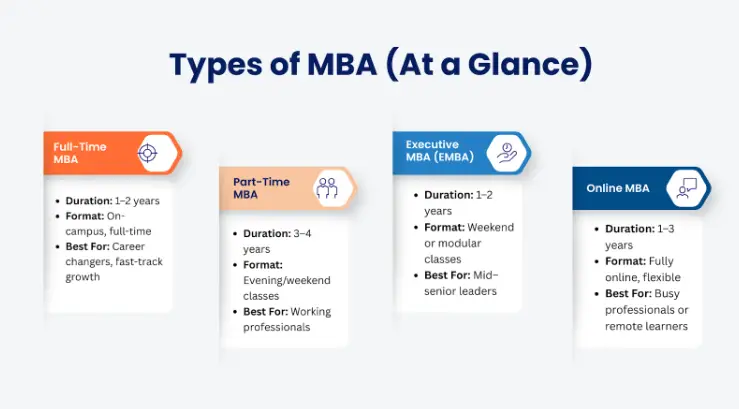
Masters of Business Administration (MBA) programs come in various formats of approaches to fit a wide range of job goals, learning styles, and routines. Here is a list of the most popular kinds:
1. Full-Time MBA:
Duration: Typically 1-2 years.
Format: Students attend classes on a full-time basis, often requiring a break from work.
Career Impact: Perfect for anyone who wish to quick-track their advancement into managerial positions or change their professional path.
2. Part-Time MBA:
Duration: Usually 3-4 years.
Format: Classes are taken in the evenings or on weekends, allowing students to continue working while studying.
Best For: Working professionals who want to advance their education while maintaining their career.
Career Impact: Ideal for those looking to enhance their skills without taking a break from work.
3. Executive MBA (EMBA):
Duration: Typically 1-2 years.
Format: Designed for senior professionals with significant work experience, classes are often held on weekends or in intensive modules.
Best For: Mid- to senior-level professionals who want to enhance their leadership and strategic management skills.
Career Impact: Focuses on executive-level leadership, making it ideal for individuals looking to advance into top executive roles.
4. Online MBA:
Duration: 1-3 years, depending on the student’s pace.
Format: Entirely online, offering flexible scheduling for students to complete coursework at their convenience.
Best For: Students who require flexibility due to location, work commitments, or other personal factors.
Career Impact: Provides the same rigorous education as on-campus programs, but with the added benefit of flexibility for busy professionals.
Depending on your job stage, family situation, and business goals, each type of MBA has its own benefits. Which one is best for you will rely on your current job, your work-life balance, and your long-term business goals.
Benefits of a Master's in Business Administration Degree
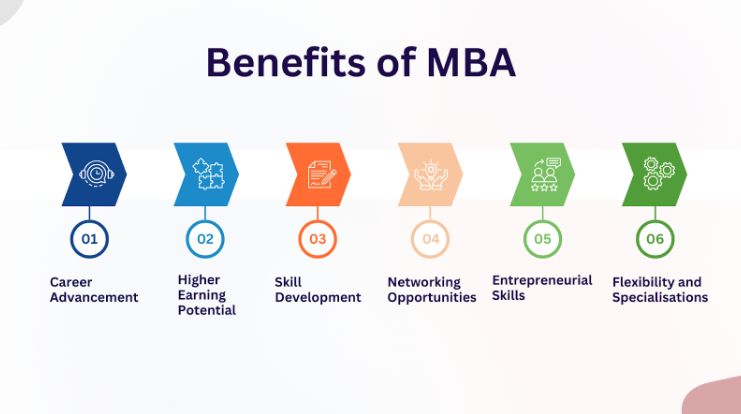
Pursuing a Master's in Business Administration (MBA) provides various benefits that will boost career prospects and long-term growth:
Career Advancement: Getting an MBA can help students to grow up their career and lead to top positions in finance, management, or consulting. Because they have more knowledge and skills, many companies prefer to hire MBA graduates for leading roles.
Higher Earning Potential: Students with an MBA usually make more money than people with only a college degree. In fields like banking, healthcare management, and tech, where MBAs are highly respected, this is especially true.
Skill Development: Important skills taught in the MBA courses include leadership, strategic thinking, financial analysis, and decision-making. The emphasis on practical applications enables students to acquire practical knowledge that directly influences their performance on the job.
Networking Opportunities: There are many opportunities to network with employees in the field, teachers, graduates, and other students in the MBA program. These links can lead to new possibilities and help to build useful work contacts.
Entrepreneurial Skills: If students want to start their own business, getting an MBA will give them the confidence and knowledge they need to do so. Students will learn about things like business planning, financial predictions, and market analysis.
Flexibility and Specialisations: Students can get an MBA in finance, marketing, or data analytics, and they can study full-time, part-time, or online. This means that you can make it fit your job goals and your personal routine.
Overall, an MBA can be a powerful step toward a more dynamic, fulfilling, and financially rewarding career.
🎓 Begin Your Master’s in Accounting Today
Complete the quick form—your new career path starts here.
Career Opportunities With A Master Of Business Administration Degree
A Master of Business Administration whether online or on campus opens doors to diverse career opportunities, from management consulting to financial leadership roles. This degree equips professionals with skills for high-demand, well-paying positions.
Career Opportunity
Description
Average Median Salary
Management Consultant
Provides business solutions to improve performance, growth, and operational efficiency.
Starts or manages a business, applying MBA skills to strategy, finance, and operations.
Depends on Business Success
FAQ's
▶ What does MBA stand for?
MBA stands for Master of Business Administration. It’s a graduate-level degree designed to provide advanced business management skills and leadership readiness.
▶ What are some of the best online MBA programs?
Among highly ranked MBA institutions, only a few offer a fully online MBA program. Many traditional top schools (such as Harvard Business School and Stanford Graduate School of Business) do not offer a fully online MBA degree; instead, they provide in-person MBA programs and may also have online business courses or certificates. Some schools, including Wharton, have expanded remote and executive-focused formats, but these are not the same as widely accessible, accredited online MBA degrees. If you’re considering a flexible format, carefully check whether the program is a fully accredited online MBA or a shorter certificate or blended offering.
▶ What skills will I gain from an MBA program?
Typical skills include leadership, strategic thinking, financial analysis, marketing, and data analytics. You’ll also build soft skills like teamwork, communication, and problem-solving.
▶ Are internships required for MBA programs?
Not all Master of Business Administration programs require internships, but a lot of schools highly promote them. Internships give students useful experience in the real world, help them make connections, and let them put what they’ve learned in the classroom into practice. Some MBA programs include jobs in their courses or work together with businesses to help students get work experience before they graduate.
▶ Is an MBA Worth It?
For many professionals seeking career growth, higher earnings, and leadership roles, an MBA is worth the investment, especially from a well-selected program. According to AACSB data, MBA graduates in the U.S. can expect average salaries of around $125,000.
However, your ROI depends on your goals, input effort, choice of school, and the network you build.
▶ How does an online MBA compare to a traditional MBA?
An online MBA offers flexibility and convenience for working professionals. They can study from anywhere, often at their own pace. A conventional MBA, meanwhile, offers face-to-face interaction, strong campus networking, and immersive experiences. Both can deliver strong value; the best choice depends on your lifestyle, budget, and career aims.
Find high-paying business administration jobs, career paths, and growth prospects. Learn the skills and qualifications needed for a successful business...