Earn a Bachelor of Financial Planning. Top online courses, careers, and salary outlooks to start your journey to a certified financial planning professional.
A Bachelor of Financial Planning helps you build expertise in investments, taxes, budgeting, and wealth management. With demand for financial planners rising, this degree opens doors to high-growth careers across the finance sector. In this blog, we explore key courses, top careers, and salaries to help you understand what a degree in financial planning offers.
Introduction
The demand for financial planning professionals continues to rise as individuals and families seek guidance on managing investments, retirement savings, and long-term financial goals. According to the latest U.S. Bureau of Labor Statistics (BLS) projections, employment for personal financial advisors is expected to grow 10% from2024 to 2034, which is faster than the average for all occupations.
A bachelor’s degree in financial planning provides students with foundational knowledge in risk management, retirement planning, investments, tax strategy, and estate planning. Many programs are aligned with CFP Board requirements, allowing graduates to pursue the Certified Financial Planner (CFP®) credential. This degree equips you with the credibility and technical skills needed in today’s financial services industry.
What Is a Bachelor of Financial Planning?
A Bachelor of Financial Planning is an undergraduate program centered on personal finance, investment management, and long-term financial strategies. Students learn how to manage both personal and client finances effectively. This program prepares graduates for roles as financial planners, analysts, consultants, and advisors - professionals who guide clients through major life decisions such as retirement, investments, taxes, and estate planning.
The curriculum blends theoretical knowledge with practical applications, often meeting the educational requirements for the Certified Financial Planner (CFP®) exam.
Key Components of Financial Planning
Investment planning
Retirement and estate planning
Tax planning
Risk management and insurance
Budgeting and cash flow management
Financial goal setting and monitoring
Affordable Bachelor’s in Financial Planning Programs
Quality financial planning education doesn’t have to come with a high price tag. Below are some budget-friendly bachelor’s programs that deliver credibility, flexibility, and career-ready skills.
Choosing the right college is crucial for a successful career in financial planning. Here are the top 10 colleges known for their comprehensive financial planning programs and industry-focused education.
Admission Requirements For Bachelor Of Financial Planning
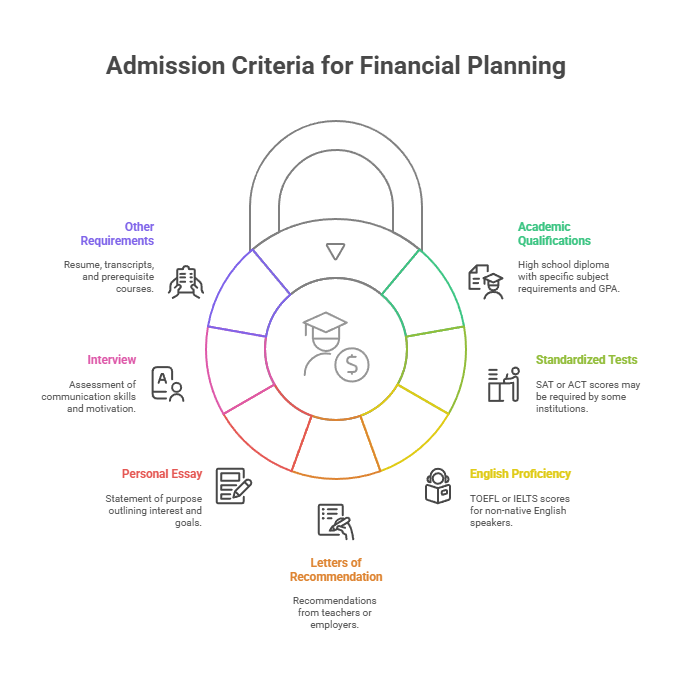
Getting accepted into a financial planning bachelor’s degree program typically requires meeting both academic and documentation standards. Most universities require a high school diploma or equivalent with a competitive GPA, though exact minimums vary. Some institutions request SAT/ACT scores, especially for first-year applicants, while others have test-optional policies.
Students are generally asked to provide transcripts, letters of recommendation, and sometimes a personal statement explaining their interest in finance. Additional requirements, such as application fees or interviews, may apply depending on the institution. Reviewing the admissions guidelines of each school ensures applicants meet all eligibility criteria and deadlines.
To be admitted into the Bachelor of Financial Planning program, applicants must satisfy the following criteria:
How long does it take to complete a Financial Planning Bachelor's Degree?
The duration to complete a Bachelor of Financial Planning degree depends on the college and the mode of study. Here's a breakdown of types:
On-Campus Program- 4 years (full-time)
Online Financial Planning Degree- 3.5 to 4 years full-time.
Part-Time Online Program- 4 to 6 years
Accelerated Program (Online or On-Campus) Duration: 2.5 to 3 years
⦿ Requires a heavier course load or transfer credits.
⦿ Ideal for motivated students aiming to graduate faster.
What Is Financial Planning And Wealth Management
Financial Planning The process of establishing financial objectives and developing a methodical strategy to reach them is known as financial planning. It includes risk management, retirement planning, tax planning, investing, saving, and budgeting. Ensuring long-term prosperity and financial stability for people or enterprises is the aim.
Wealth Management Wealth management is a full-service financial solution that includes investment management, financial planning, and other financial services. It usually serves wealthy people and covers things like estate preparation, tax strategies, portfolio management, and keeping wealth safe.
Aspect
Financial Planning
Wealth Management
Scope
Focused on budgeting, saving, retirement, and insurance
Includes financial planning + investments, tax, estate, etc.
Services Offered
Budgeting, retirement, insurance, and tax planning
Personalized, hands-on management of total financial assets
Why Get a Financial Planning Degree?
As more people, families, and organizations look for professional advice to manage their money, save for retirement, and accumulate wealth, the need for financial planning specialists is growing. Students who get a degree in financial planning have a thorough understanding of risk management, investment methods, and economic fundamentals.
Competitive pay is possible for certified financial planners. According to the U.S. Bureau of Labor Statistics, the typical yearly compensation for personal financial advisers in the United States is around $102,140.
You will acquire abilities that are useful in both personal and professional settings, such as financial analysis, risk management, estate planning, tax planning, and investment strategy.
In addition to preparing you for a profession, the degree also enables you to make wise financial choices for yourself.
Graduates may pursue careers in independent advising, banking, wealth management, insurance, and consultancy.
Getting a degree in financial planning has never been easier, thanks to the growing availability of online courses. In order to help customers achieve long-term financial success and stability, financial planners are essential.
Career Opportunities For an Online Financial Planning Degree Bachelor's
Graduates of a Bachelor of Financial Planning program have access to a wide array of careers in the finance sector. The BLS projects over 942,500 openings annually between 2024 to 2034, across business and financial occupations. This reflects strong demand across banks, investment firms, insurance companies, and advisory services.
Below are common career paths, each with concise job descriptions and median salary:
Job Title
Job Description
Average Annual Salary (2025)
Financial Planner
Creates personalized investment and savings plans for clients
Helps clients prepare for retirement and long-term financial goals
▶ Can I pursue a financial planning degree online?
Yes, many colleges offer a financial planning degree online. These programs cover the same curriculum, financial analysis, retirement planning, and investment strategies, and they are flexible enough for working professionals or remote learners to complete from the comfort of their own homes.
▶ What skills will I gain from a financial planning degree?
Students who earn a degree in financial planning will learn how to manage risk, create a budget, plan for retirement, prepare taxes, invest, and analyze finances. People and businesses learn how to deal with clients, talk to them, and make ethical decisions to responsibly achieve their financial goals.
▶ Is a financial planning degree worth it?
Financial planning degrees are smart investments. It offers stable, in-demand personal wealth management and financial positions. Due to public interest in financial literacy, graduates have good job prospects, competitive compensation, and important work helping customers protect their financial futures.
▶ Do I need any certifications after obtaining a financial planning degree?
Although not mandatory, certifications such as the Certified Financial Planner (CFP®) significantly boost credibility and job opportunities. Many employers prefer or require certification due to its demonstration of advanced knowledge and ethical standards.
▶ What is the highest-paying job for a bachelor's degree in financial planning?
Some of the highest-paying roles you can work toward with a bachelor’s in financial planning include financial adviser and wealth-management advisor. According to Indeed, financial advisers earn an average of around $195,000 per year, making it one of the top-paying finance roles accessible with this degree. With experience, certifications like the CFP®, and specialization in high-net-worth clients, earnings can increase significantly.
Cookie Consent
We use cookies to improve your experience on our site. By using our site, you consent to cookies.