Explore the best master’s in computer engineering programs, suitable career paths, and admission requirements. Find affordable and top-ranked MS degrees.
Want to advance your career at the intersection of hardware and software innovation? A master’s in computer engineering could be your gateway to designing the future - from AI systems to autonomous vehicles.
Introduction
A Computer Engineering master's can significantly improve your earning potential! According to the U.S. Bureau of Labor Statistics (BLS), computer hardware engineers earned a median annual salary of $155,020 (2024).
A Master’s in Computer Engineering helps students build advanced skills in computing systems, embedded software, and digital design, especially by preparing them for leadership roles in technology and research. With rapid advancements in AI, robotics, cybersecurity, and semiconductors, the demand for professionals with specialized technical expertise is higher than ever.
Whether you aim to innovate hardware systems, optimize algorithms, or develop intelligent software applications, earning an MS in Computer Engineering can open doors to some of the most rewarding tech careers. Discover the best universities, program types, and career opportunities in this high-demand field.
Affordable Computer Engineering Master’s Programs
If you are aiming for a master’s in computer engineering without breaking the bank, several universities offer affordable, high-quality programs.
Many public universities provide in-state tuition and assistantship opportunities. This makes them ideal for budget-conscious students. Review the table below to compare costs, program formats, and available funding opportunities.
Tip: When comparing costs, look beyond tuition, consider research opportunities, internship placements, and funding options such as graduate assistantships or scholarships for STEM majors.
Top Computer Engineering Master’s Programs
Before exploring the best programs, keep in mind that rankings are influenced by factors like faculty expertise, research output, industry connections, and post-graduation outcomes.
Here is a list of some top-ranked universities for MS in computer engineering.
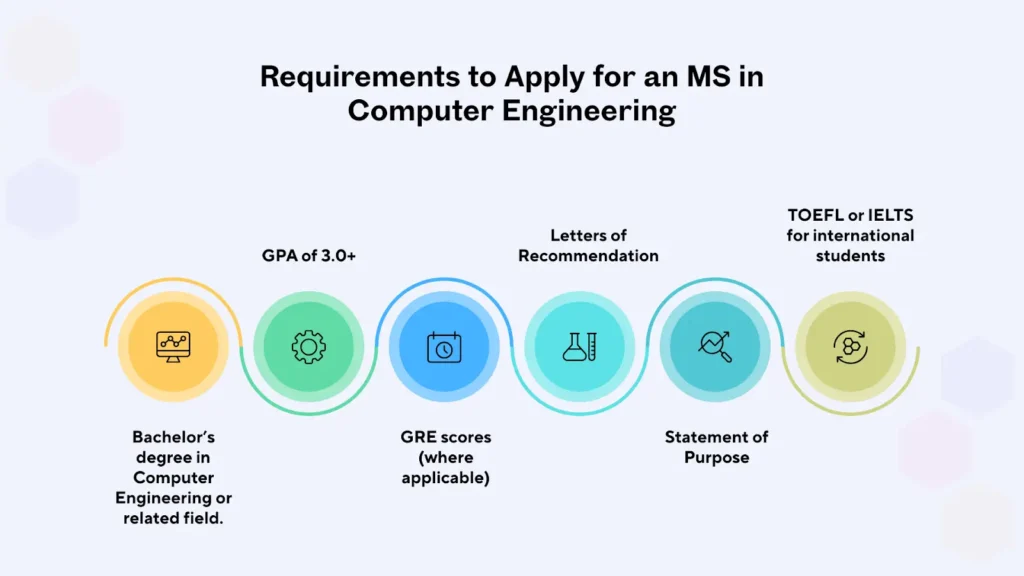
GPA of 3.0 or higher (on a 4.0 scale): A strong GPA indicates academic readiness for the advanced coursework and research involved in a master’s in computer engineering.
GRE scores: While many institutions have made the GRE optional, a good score can still strengthen your application.
Letters of recommendation from academic or professional sources: These letters should ideally come from professors, supervisors, or research mentors who can speak to your technical ability, work ethic, and analytical thinking.
Statement of purpose outlining your career goals and research interests: This is your opportunity to express why you’re pursuing anMS in Computer Engineering, and how it aligns with your long-term goals
English proficiency test scores: (TOEFL or IELTS) for international students.
In addition, many schools value hands-on experience through internships, coding projects, or undergraduate research. Students with a solid foundation in digital systems, microprocessors, and computer architecture stand out in competitive programs.
For students with limited experience, participating in online computer engineering certifications or open-source engineering projects can help bridge that gap and make their application more competitive.
Why Get a Computer Engineering Master’s Degree?
Earning a Master’s in Computer Engineering can significantly elevate your technical and professional profile. Here’s why:
Higher Earning Potential:Payscale reports, graduates with a master’s computer engineering degree earn an average salary of $114,000 per year, with senior-level positions exceeding $140,000.
Career Advancement: The degree positions you for roles in system design, hardware-software integration, and AI engineering. These positions often lead to leadership or R&D roles.
Specialization Opportunities: Many computer engineering master’s programs offer concentrations in areas like machine learning, VLSI design, or cybersecurity, which allow you to customize your studies to your interests.
Research and Innovation: Students gain access to advanced research labs and often collaborate with tech companies on real-world challenges.
In short, an MS in Computer Engineering is more than a degree; it’s an investment in the technologies that shape tomorrow.
What to Expect From Computer Engineering Graduate Programs
Computer engineering master’s programs typically take 1.5 to 2 years to complete. This depends on whether you choose a thesis or non-thesis path.
Here’s what you can expect during your studies:
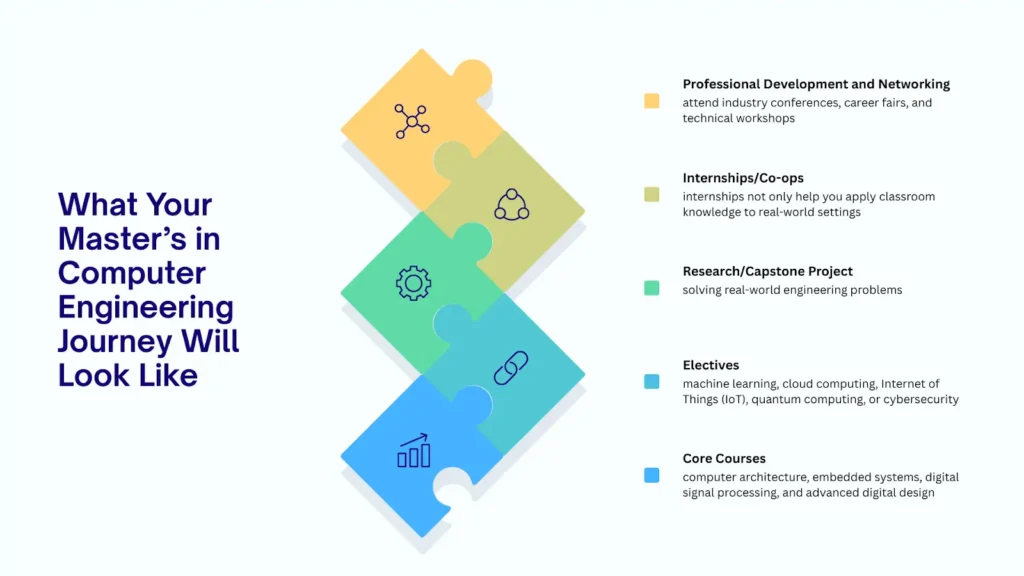
Core Courses: You will study topics like computer architecture, embedded systems, digital signal processing, VLSI (Very Large Scale Integration), and advanced digital design. These courses help you understand how hardware and software integrate to create efficient computing systems.
Electives: You can choose from emerging areas like machine learning, cloud computing, Internet of Things (IoT), quantum computing, or cybersecurity.
Research/Capstone Project: Hands-on experience solving real-world engineering problems. This could involve designing an embedded AI system, improving processor efficiency, or developing new hardware for IoT devices.
Internships/Co-ops: Many programs offer placements in major tech companies or research centers. These internships not only help you apply classroom knowledge to real-world settings but also build professional networks.
Professional Development and Networking: Beyond academics, many universities encourage students to attend industry conferences, career fairs, and technical workshops. These experiences help you connect with peers, alumni, and employers.
By the time you graduate with an MS in Computer Engineering online or on-campus,, you’ll have the technical expertise, research experience, and professional confidence. These strengths prepare you for careers in hardware design, software systems, robotics, and emerging AI technologies, making this degree a smart long-term investment for your future.
What are the Career Opportunities for an M.S. in Computer Engineering?
A master’s in computer engineering opens up a wide range of career paths in both hardware and software industries. Graduates can pursue roles such as:
Career Role
Description
Average Annual Salary (USD)
Computer Hardware Engineer
Designs, tests, and develops computer hardware components such as processors, circuit boards, and memory devices. Works on improving computing performance, power efficiency, and integration with new technologies.
Plans and designs complex computing systems that combine hardware, software, and networking to meet business or research goals.Ensures scalability, performance, and security of IT infrastructure.
Builds and trains algorithms that allow systems to learn from data and make predictions or decisions autonomously.Works in AI-driven fields such as natural language processing, robotics, and computer vision.
Develops embedded software and hardware systems used in electronics, automobiles, and medical devices.Focuses on integrating low-level programming with hardware efficiency and reliability.
Protects networks and systems from cyber threats through firewalls, encryption, and continuous monitoring. Implements security frameworks and performs risk assessments to prevent breaches.
Designs and programs connected smart devices that communicate through the Internet of Things (IoT). Focuses on device connectivity, automation, and real-time data analysis for applications in healthcare, smart homes, and industry.
Specializes in creating integrated circuit (IC) layouts for microchips used in computing, smartphones, and embedded devices.Works on chip optimization, low power consumption, and next-generation semiconductor design.
According to the U.S. Bureau of Labor Statistics (BLS), employment of computer hardware engineers is projected to grow by 7% through2034, about as fast as the average for all occupations.
Additionally, software-centric positions, such as software developers, quality analysts, are growing even faster by 15%, fueled by demand for intelligent systems and connected devices.
The future of innovation depends on those who can bridge hardware and software, and that’s exactly what a Master’s in Computer Engineering prepares you to do. Whether you choose a traditional campus program or an online computer engineering master’s degree, make sure it aligns with your career goals, learning style, and financial plan.
💻
Future-Ready Computer Engineering
Start exploring your options today and take the first step toward a rewarding, future-ready career in computer engineering.
▶ How long is a Master's degree in computer engineering?
Most computer engineering master’s programs take between 1.5 to 2 years to complete full-time. Part-time and online options may take up to 3 years, depending on your pace and program structure.
▶ Which is better, CS or EE?
It depends on your career interests. Computer Science (CS) focuses more on software, algorithms, and data structures, while Electrical Engineering (EE) emphasizes hardware, circuits, and systems. Computer Engineering blends both, ideal for students who enjoy working with both hardware and software.
▶ What is a Master's in computer engineering?
A master’s in computer engineering is a graduate-level program that teaches advanced concepts in computer systems, electronics, and software design. It prepares students for specialized roles in technology development, automation, and R&D.
▶ Is a master's in computer engineering hard?
It can be challenging, especially for students new to hardware or programming. However, strong mathematical and problem-solving skills, along with consistent practice, make it manageable and rewarding.
▶ What is the highest-paid job in computer engineering?
Roles like AI Engineer, system software engineer, and Machine Learning Engineer are among the top-paying, with salaries often exceeding $150,000 annually, depending on experience and location.
Cookie Consent
We use cookies to improve your experience on our site. By using our site, you consent to cookies.